About Pyrola grandiflora Radius
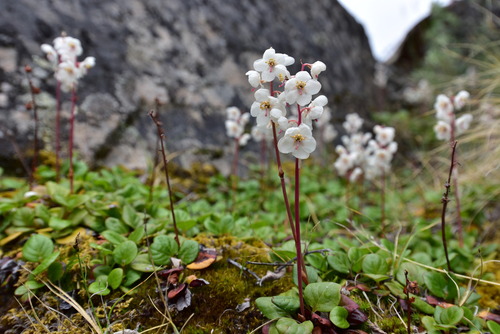
Pyrola grandiflora Radius, also known as largeflowered wintergreen, is classified by the United States Department of Agriculture (USDA) as a perennial evergreen subshrub. Mature individuals never exceed 1 meter in height, and typically grow between 3 and 25 cm tall, staying under 0.5 meters. It has simple basal leaves borne on long petioles. Its leaves have pinnate venation, obtuse or rounded blade bases, rounded apices, sub-entire margins, and a glabrous surface. The abaxial (lower) leaf surface is dull and pale, while the adaxial (upper) surface is shiny, dark green, and leathery to the touch. White tissue sometimes borders larger veins on the adaxial leaf surface. Unlike deciduous plants, this species is evergreen, so its leaves persist year-round. Pyrola grandiflora has a circumpolar distribution across the Northern Hemisphere, found in Greenland, Canada, the United States (including Alaska), Yukon, Northwest Territories Islands, continental Northwest Territories, Nunavut Islands, continental Nunavut, northern Quebec, Eurasia, and the Arctic. It grows in hemiboreal, taiga, and tundra climates within its circumpolar Northern Hemisphere range. This perennial subshrub can grow on many different substrates in alpine tundra, heathlands, coniferous forests, boreal (taiga) forests, woodlands, slopes, ridges, dry meadows, stony locations, and imperfectly drained moist or dry areas. It also grows on humus in shrubby tundra, where it occurs alongside Vaccinium uliginosum, Salix alaxensis, and Betula glandulosa. Its flowering season typically runs from April to June. While other Pyrola species such as Pyrola asarifolia have been used to treat urinary diseases, mouth and throat inflammations, postpartum swelling, hemorrhoids, and insect bites, no studies have been found to confirm that Pyrola grandiflora also has medicinal properties.