About Pyrgus serratulae (Rambur, 1839)
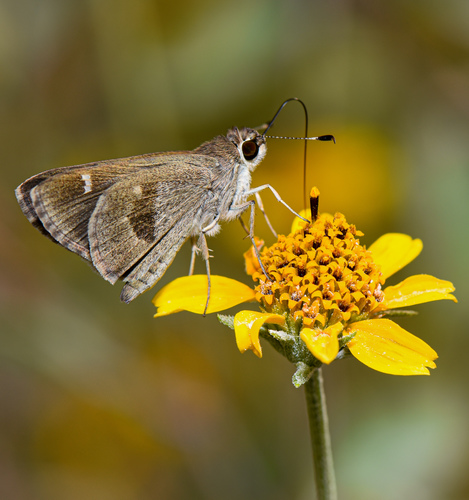
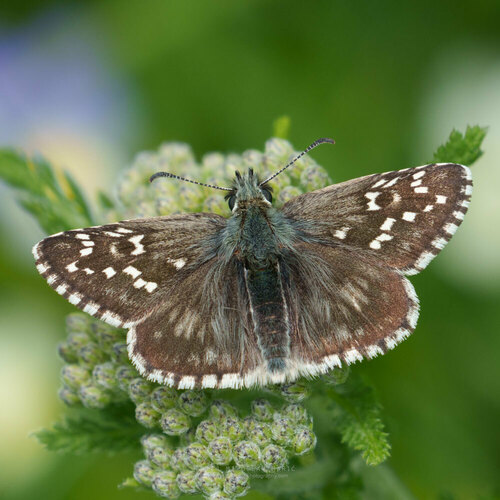
Compared to other species in the genus Pyrgus, Pyrgus serratulae (Rambur, 1839) is relatively distinctive. The upperside of its wings is plainer than most of its close relatives, with only tiny white marks on the forewings and almost no markings on the hindwings. The underside of the wings is usually mostly olive-green with paler markings, and an oval basal spot on the underside of the hindwing is a mostly well-developed feature. Alpine populations of this species often have an upper wing pattern where bright spots are strongly and almost completely reduced. This is a medium-sized Pyrgus species, with a wingspan of 24–28 mm. Pyrgus serratulae can easily be confused with butterflies of the Pyrgus alveus complex (which may occur syntopically with it) as well as other species in the genus Pyrgus; reliable identification requires examination of genitalia. Pyrgus serratulae is a species native to mountainous regions of Europe, but it is not found in the British Isles or Scandinavia. Its distribution extends from southern European mountains through western, central and eastern Europe, via south-western Siberia, to Mongolia and northern China. It also occurs across Asia Minor, Transcaucasia, and reaches as far as north-western Iran and north-eastern Iraq. In north-western Germany, its range extends to East Westphalia, and in north-eastern Germany it reaches the vicinity of the Baltic Sea. This species inhabits limestone grasslands or alpine grasslands on shallow, often rock-interspersed terrain, as well as rock corridors on mostly alkaline rocks. In the Alps, it is often found in avalanche tracks and erosion channels. It also occurs in grasslands dominated by Nardus stricta. Adult Pyrgus serratulae fly in July and August across much of its range, but its flight phenology varies substantially across its wide altitudinal distribution. In the Alps, the flight period starts in mid-June (or early June in unusually warm springs), peaks in July, and adults are still regularly recorded from August to early September. In lower elevations of northern Bavaria, adults emerge one month earlier: they typically appear in May (late April in very warm springs), peak in June, and the last adults can be seen until the end of July in some years. Adult Pyrgus serratulae orient optically toward small or large rocks, rock edges, banks, or other open ground structures. Oviposition occurs in very gappy, vegetation-poor locations, usually on individually growing cinquefoil plants. Confirmed caterpillar host plants are Potentilla tabernaemontani (also classified as Potentilla neumanniana and Potentilla verna), Potentilla heptaphylla, Potentilla recta, Potentilla aurea, Potentilla crantzii, Potentilla hirta, Potentilla pusilla, Potentilla reptans, Sibbaldia montanumbens and Heliantum reptanumbens. Eggs are laid singly on the underside of host plant leaves. Based on oviposition observations and caterpillar records, larval development occurs in full sun, in locations that warm quickly. Cinquefoil plants growing on or directly next to rocks are often used for larval development. Larval development also occurs on open, low-vegetation sites with rocky-gritty soil, or along unpaved paths. Like other Pyrgus, caterpillars spin characteristic leaf bags. In extra-alpine areas, the most important food plant group is Potentilla verna agg., with only very few recorded oviposition events on Potentilla erecta. In the Swabian Alb, Potentilla heptaphylla is preferred over Potentilla verna. In the Alps specifically, other Potentilla species are important caterpillar food plants. Caterpillars in northern Bavaria overwinter in the penultimate larval instar, and develop into adults as early as April. Larval development may take longer in the Alps. Male Pyrgus serratulae frequently feed on moist ground and sweat. When visiting flowers for nectar, adults are opportunistic and visit flowers from multiple families with a range of different colors.