About Pyrgus malvae (Linnaeus, 1758)
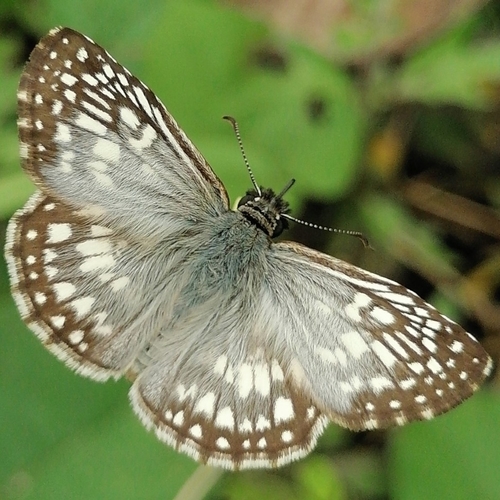
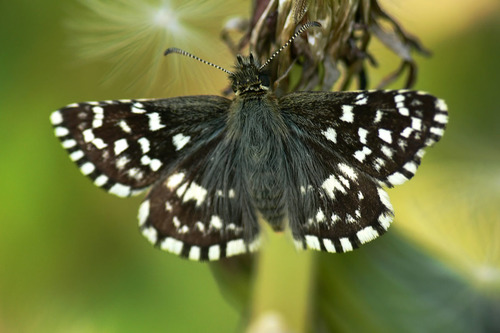
Pyrgus malvae, commonly known as the grizzled skipper, is easily recognized by its characteristic chequered black-and-white pattern. It is a small species, with an average forewing length of 12 millimeters, and has an appearance very similar to moths. Males and females can be told apart by wing shape: males have slightly more angular wings, while females have more rounded wings. Larvae are green and light brown with darker brown stripes. According to Seitz's description of P. malvae: the terminal row of white dots is developed, at least on the hindwing. The underside of the hindwing is reddish, with distinct white dots, and the dots in the subterminal band are rounded. Veins are bordered with yellowish white or white. In the aberration taras Bergstr.(86a), the white spots of the forewing are united into bands; this form occurs singly among ordinary individuals. The species ranges across Europe and Asia from the Mediterranean Sea to the Amur River, and also occurs in Mongolia. The larva is yellowish grey, minutely dotted with greenish, each dot bearing a short thin hair, with a darker dorsal line and yellowish spiracles. Larvae can be found in June and October feeding on Potentilla, Dipsacus, strawberry, raspberry, and other plants. Adult butterflies are in flight in April and May, and again from the end of July onward, found on sunny slopes, field-side roads, and woodland clearings, and are common throughout most of Central Europe. Pyrgus malvae is found across Western Europe, including northern Scandinavia, parts of Greece, and some Mediterranean Islands. Populations are recorded as quite stable in many European countries. It is also present in Korea, occurs throughout the Mediterranean region extending north to central Finland, and is rare in parts of Germany. Grizzled skippers can occupy three main habitat types, and they tend to settle in areas that have spring nectar plants, larval food plants (including agrimony, creeping cinquefoil, wild strawberry, and tormentil), ranker vegetation, and edges adjacent to scrub or woodland. Host plants belong to the family Rosaceae, with a focus on Agrimonia eupatoria and species of Potentilla. The first main habitat type is woodland, which mainly consists of sparsely distributed vegetation and may have areas of bare ground created by cutting or windblow. The second is grassland, which forms under three different disturbance or management patterns: 1) Scrubby grassland that contains bramble and wild strawberry; 2) Unimproved grassland that contains creeping cinquefoil; 3) Unimproved grassland that contains agrimony. The third is industrial habitat, which has sparse vegetation dominated by either wild strawberry or creeping cinquefoil, depending on whether the site is along a railway or a clay working. These industrial sites are typically recently abandoned. Additional habitats that this butterfly may occupy include heathland, shingle, sand dunes, and acidic, neutral, and marshy grassland. Pyrgus malvae is particularly responsive to warmer and drier climates, with warmer summers being more favorable for the species and positively correlated with population success. This may stem from the link between warmer temperatures and the success of both female egg-laying and larval survival. Warmer temperatures also speed up larval development, allowing an earlier start to the pupal stage. Cooler conditions in the far north may explain why the species is concentrated in southern regions. Despite this preference for warmth, climate warming has been associated with decreases in the species' northern range margin, total distribution area, and abundance. This response is thought to depend on both climatic and non-climatic driving factors. Studies show that grizzled skippers have a concentrated preference for specifically colored flowers when foraging. They are most attracted to blue and violet flowers, and show little to no attraction to white, yellow, or red flowers. Butterflies in the Hesperiidae family have ultraviolet and blue light receptors that may be responsible for their favoring of blue. This evidence indicates that when this species forages for food, it is particularly responsive to the short-wavelength light reflected off these flowers. In fact, this preference aligns with the well-documented preference for blue that most members of the Hesperiidae exhibit. This preference may stem from phylogenetic adaptations, foraging signals, and learning abilities. Specifically, the higher prevalence of blue flowers in lowlands could further strengthen this preference, especially for grizzled skippers that occupy lowland grasslands.