About Pyrgus armoricanus (Oberthür, 1910)
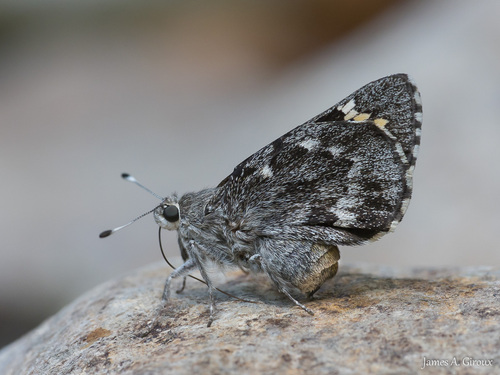
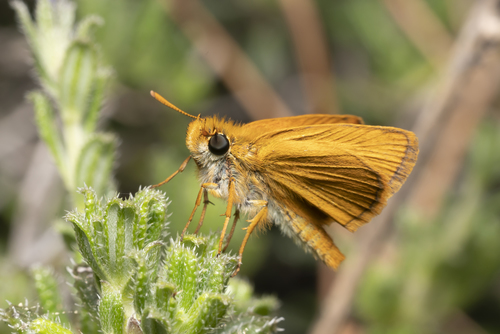
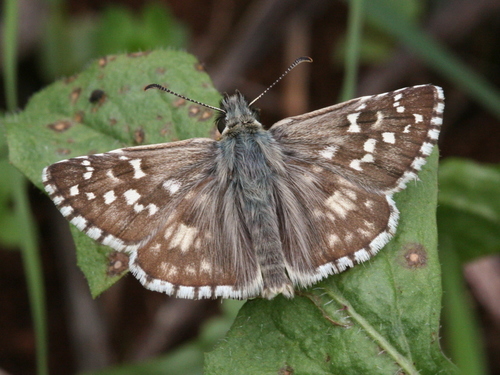
Pyrgus armoricanus (Oberthür, 1910) is a skipper butterfly with a 24–28 mm wingspan. Both of its wings have a white fringe along their edges. The upperside of its forewings is dark brown with well-developed white markings, and the upper surface of its hindwings has clearly visible grayish marks. The underside of the hindwings is pale reddish-brown, with a large pale discal spot and light-colored veins. Males and females have similar appearance. Like all species in the Pyrgus genus, Pyrgus armoricanus can be very hard to identify in the field. Compared to other Pyrgus species, especially fresh individuals, the upperside of its forewings is often noticeably darker brown with clearer white markings. It looks similar to some smaller races of the large grizzled skipper (Pyrgus alveus), is slightly larger than Pyrgus malvae, and is also quite similar to Pyrgus carthami and Pyrgus serratulae. Without examination of its genitalia, there is a high risk of confusing this species with butterflies of the Pyrgus alveus complex and Pyrgus cirsii, though it can be distinguished from Pyrgus alveus by the clearly lighter white spots on the upperside of its hindwings. The eggs of Pyrgus armoricanus are yellowish, roundish, flattened, and marked with numerous strong longitudinal ribs. Caterpillars have short, stiff hairs; most are dark brown to gray-brown, rarely greenish brown or reddish-brown, and have black heads. Pupae are heavily bluish-frosted, with black dots and dashes on the back. Pyrgus armoricanus is distributed from northwest Africa across southern Europe and parts of central Europe to southern Scandinavia. To the east, its range extends to southern Russia, and across Asia Minor to Iran. It is more common in the southern portion of its range, and is absent from the British Isles. This species occupies a wide variety of open habitats with raw soils. These include semi-dry and sandy grasslands, ruderalized areas, and worn footpaths on unpaved routes. Habitats can vary widely depending on the local natural area and soil substrate, but all larval habitats have sparse, short vegetation. It can also colonize poor grasslands and mesophilic grassland stands, as long as these areas have enough open ground spots, such as molehills, roadsides, and median strips of unpaved roads. Within its overall range, Pyrgus armoricanus occurs at elevations from 0 to 1800 m above sea level. In Bavaria, recorded elevations range from about 190 m in Main Franconia to just over 800 m above sea level on the edge of the Alps. Permanent breeding populations are found between 200 m and 500 m elevation. Generally, in central Europe Pyrgus armoricanus has a narrow altitude range, and is mostly limited to lower elevations. Pyrgus armoricanus flies in May and June across much of its range, with a second generation in August and September in the southern portion of its range. On average, it develops two generations per year in Bavaria. In increasingly frequent above-average warm years, a partial third generation may develop; in exceptionally warm years, a full third generation can occur, which happens regularly in the Mediterranean region. The flight period of the first generation usually runs from late May to late June, but in very warm springs, adult butterflies can emerge as early as three weeks earlier in May. The second generation usually flies from mid-August to mid- or late September, though flight times are significantly earlier in very warm summers. Smaller shifts to flight timing may also occur depending on general weather conditions. Adults of the second generation are typically smaller than those of the first generation. Females lay eggs individually on the underside of host plant leaves. Eggs are laid on plants growing in full sun, which most often grow over open soil or dark litter, such as dry floating debris on river banks. Bare soil with little vegetation and dark subsoil speeds up warming of the egg site. Most habitats are flat, with south-facing slopes used comparatively less often, and extremely xerothermic (hot, dry) sites are rarely colonized even when host plants are abundant. Caterpillar habitat indicates that Pyrgus armoricanus has a moderate moisture requirement for larval development. Small, isolated habitats are only colonized during or after very favorable years. In these habitats, Pyrgus armoricanus experiences strong population fluctuations with temporary total local extinction, which indicates a metapopulation structure. Adult butterflies regularly visit flowers to feed on nectar, and use a wide range of flowering species for this resource. Both males and females orient visually, and actively seek out sparsely vegetated areas to sunbathe and search for potential egg-laying plants. Across most of Europe, larvae feed on Potentilla species including Potentilla tabernaemontani, Potentilla reptans, Potentilla arenaria, and Potentilla pedata, as well as woodland strawberry (Fragaria vesca). In southern Scandinavia (Sweden and Denmark), the main larval food plant is Filipendula vulgaris, with Helianthemum nummularium also used to some extent. To date, Potentilla verna agg. and Potentilla reptans have been documented as larval food plants and egg-laying hosts in Bavaria. Confirmed caterpillar food plants include: Potentilla neumanniana (syn. Potentilla tabernaemontani, Potentilla verna) in southwest Germany and other areas, Potentilla reptans in southwest Germany and other areas, Potentilla argentea in southwest Germany and other areas, Potentilla recta in the Upper Rhine region, Potentilla erecta in the Black Forest, Italy, and Salzburg, Potentilla sterilis (syn. Potentilla fragariastrum) in the Black Forest, Potentilla pusilla in Switzerland and Italy, Potentilla hirta in France, Potentilla gelida in Russia, Potentilla pedata in Russia, Filipendula vulgaris in Sweden, Fragaria vesca in the Palatinate, Agrimonia eupatoria in the Palatinate, Helianthemum nummularium agg. (syn. Helianthemum vulgare) (oviposition observed across multiple regions, and rearing on this plant is successful), and Helianthemum ovatum in Lower Austria. Caterpillars of this species overwinter.