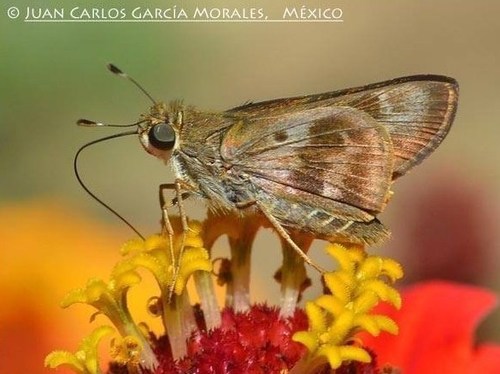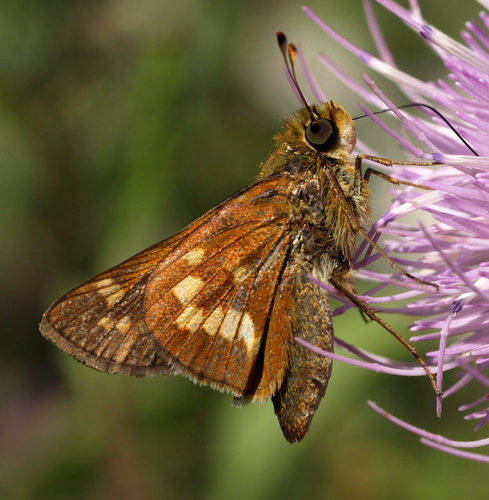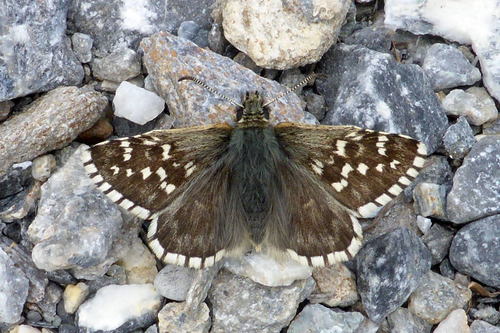
About Pyrgus andromedae (Wallengren, 1853)
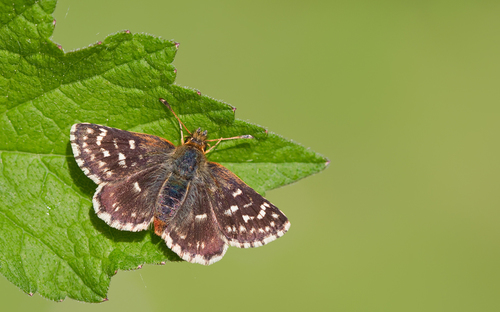
Pyrgus andromedae (Wallengren, 1853), commonly called the Alpine Grizzled Skipper, is a medium-sized Pyrgus skipper with a wingspan of 26–30 mm. Its dark brown forewing has a bold pattern of white spots, while the hindwing is plain dark brown with little to no patterning. The underside of the hindwing has two distinctive pale markings near the dorsum: an elongated streak and a round spot that are often compared to an exclamation mark (!). When identification is uncertain, examination of the genitals is required for a reliable determination. This is the only boreo-alpine Pyrgus species in Europe, and it is a European endemic. It occurs at high altitudes across much of Europe, and can be found at fairly high altitudes in the Alps, the rare population in the Pyrenees, and Pirin. It also occurs at lower elevations in northern Scandinavia, where its range extends well into the Arctic Circle. It is also recorded from the Carpathians, southwest Bosnia, southwest Serbia, northwest North Macedonia, Lapland, and on the border between Norway and Sweden. In the Alps and Pyrenees, its natural habitat sits above the tree line in damp, grassy areas, often close to streams or bogs. In its Scandinavian range, it occurs in areas with dwarf scrubby vegetation, on steep slopes, and in rocky areas. It prefers damp habitats, and is frequently found near water. The main populations of P. andromedae in the Alps occur in alpine altitude calcareous locations, where grasslands are dominated by Sesleria caerulea and Carex firma. At low altitudes below 800 m, it typically occupies gravel banks in the alluvial areas of mountain rivers and their peripheral areas. Habitats at the subalpine level include open light mountain forests mixed with poor grass, stony and poor alpine pastures, avalanche lines, rubble heaps, brook banks, feistluras, or embankments with pioneer lawns created by road construction. In the Swiss Alps its altitude range is 1,000 to 2,700 metres (3,300 to 8,900 ft), in the Pyrenees it ranges from 1,500 to 2,000 metres (4,900 to 6,600 ft), and in Bavaria it is usually found between 900 m and 2000 m in altitude. Across its entire range, P. andromedae produces one generation per year. In Bavaria, the first adult butterflies (imagos) are observed from mid-May. The main flight period runs from early June to mid-July, with very few recorded sightings after the first week of August. Its seasonal phenology is strongly dependent on spring mountain weather; after winters with little snow and extremely warm springs, the phenological maximum can occur as early as the end of May. In Bavaria, significantly more individuals have been observed in odd-numbered years than in even-numbered years. P. andromedae flies rapidly, low to the ground. Adult imagos use a variety of plants for nectar, and can also be found foraging in subalpine tall herbaceous meadows, fatty willows, or spring swamps when visiting flowers. They rest on stones, open soil, or exposed leaves. Males occupy territories to find mates, preferring stream banks or tall herbaceous meadows. For successful reproduction, P. andromedae requires well-sunlit stands of Dryas octopetala, which is likely the species' only host plant. Dryas octopetala grows mainly on shallow, humus-poor, base-rich stone and rock soils, and is a pioneer species on dormant rock rubble heaps. To lay eggs, the female searches for a suitable leaf and curves her abdomen to attach each egg individually to the underside of the leaf. The key importance of Dryas octopetala as an egg-laying site and host plant for P. andromedae was only recognized recently. For a long time, incorrect information about egg-laying and host plants such as cinquefoil species (Potentilla spp.) was circulated, likely because pre-imaginal stages or imagos of this species were confused with those of other Pyrgus species, especially Pyrgus cacaliae. Existing reports of mallow (Malva spp.) or Alchemilla spp. as host plants are also unreliable. In Bavaria, eggs are laid from mid-June to the end of July on heavily sunlit Dryas octopetala cushions in rock-strewn terrain, and eggs are always laid individually. Caterpillars spin a silken web and pull leaves together to create a shelter, where they congregate. They hibernate over winter, then pupate inside a similar shelter the following spring. A two-year development cycle was observed in the Rätikon region (Vorarlberg) at altitudes above 2000 m: first instar caterpillars only feed for a few days before building a leaf shelter on the host plant for their first hibernation, and a second hibernation occurs in the pupal stage. When developing in lowlands, caterpillars develop directly into pupae, which then overwinter. Breeding observations also note that caterpillars grow at different speeds: some overwinter in the second caterpillar stage, while others overwinter already as pupae.