About Pyrgus alveus (Hübner, 1802)
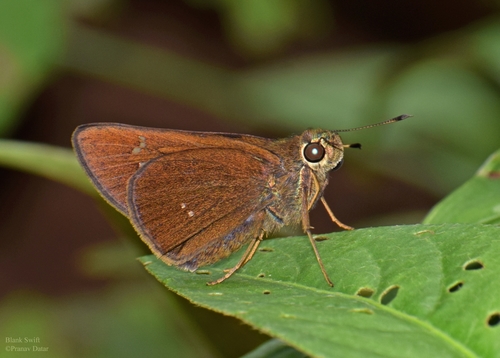
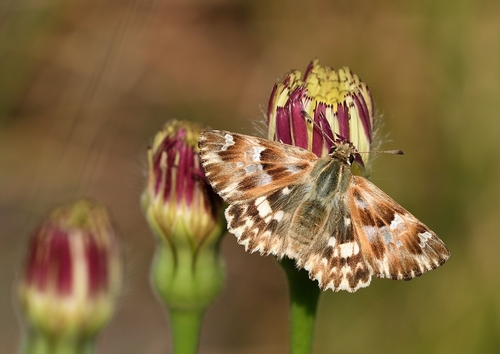
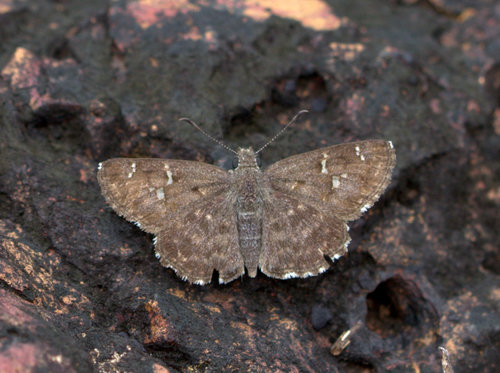
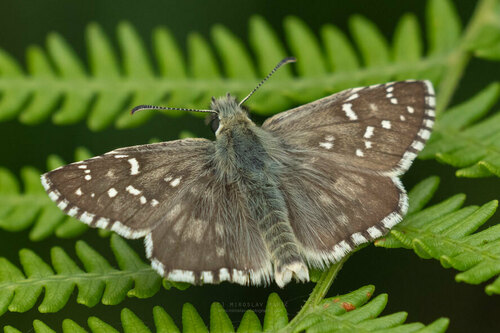
Pyrgus alveus (Hübner, 1802) is a rather variable species with a wingspan of 22–32 mm, where its common name reference to "large" is not always accurate. Several subspecies have been described for this species. Like most Pyrgus species, it has dark brown wings with pale chequered margins, making it difficult to identify to the species level in the field. Clear, well-spaced white spotting on the forewing and much fainter markings on the hindwings can be seen when the individual is observed well. The species complex Pyrgus alveus agg. has not yet been adequately studied from a taxonomic perspective. In particular, separating and evaluating the taxa Pyrgus alveus, Pyrgus trebevicensis, and Pyrgus accretus is considered extremely problematic. For this reason, reports of these taxa in many cases cannot be clearly assigned, and no taxonomic separation based on biological differences within the complex has been confirmed. Many authors therefore treat Pyrgus trebevicensis and Pyrgus accretus as synonyms, subspecies, or ecological forms of Pyrgus alveus. Due to these unsolved taxonomic and identification issues, the Pyrgus alveus / Pyrgus trebevicensis complex is referred to as Pyrgus alveus agg. below. Pyrgus alveus agg. is similar to Pyrgus warrenensis and Pyrgus armoricanus. These two species already show macromorphological differences from Pyrgus alveus / Pyrgus trebevicensis; in particular, individuals of Pyrgus alveus / Pyrgus trebevicensis are larger on average. Even so, genital morphological identification is recommended, and it is unavoidable in areas where these taxa occur syntopically. The Pyrgus alveus agg. species complex ranges from northwest Africa across the mountains of the Iberian Peninsula, southern Europe (the Apennines and Balkan Peninsula), western Europe, central Europe (extending to the southern North German Plain), and Eastern Europe to Transbaikalia. Only the southern part of Fennoscandia in Northern Europe is populated. To the southeast, the range extends across Anatolia to the Caucasus. The complex is absent from Denmark and almost all European islands, including Great Britain, Ireland, the Azores, the Balearic Islands, the Channel Islands, the Canary Islands, Crete, Cyprus, and Iceland. Populations of Pyrgus alveus agg. are mainly associated with limestone grasslands, which form the primary habitat in the main distribution area of the Franconian Jura. Populations in the Bavarian Alps inhabit limestone grasslands, alpine grasslands, and lean alpine pastures. Sand grasslands are also occupied locally, for example in the foothills of the Middle Franconian Jura and the Danube-Isar hill country. Occurrences in the Mittelvogtland hill country are also found on silicate grasslands. All of these are nutrient-poor sites that, except for alpine populations, are usually grazed regularly and have a corresponding short-grass structure. In Bavaria, the phenology of Pyrgus alveus agg. spans a four-month period. This holds for both alpine and extra-alpine regions of Bavaria, and the period is only slightly shorter than what is recorded for the Swabian Alb in Baden-Württemberg. The flight period begins in mid-May and ends in mid-September. Despite the long window in which adult imagos can be observed, current knowledge confirms that Pyrgus alveus agg. only produces one generation per year in central Europe. The long development time of caterpillars also supports that a second annual generation does not occur. Flight times vary across the wide elevation range found in the Alps. The altitude distribution extends from the colline level at almost 300 m in Grabfeldgau and the Haßberge in northwest Bavaria to the alpine zone at 2100 m in the Allgäu high Alps. The majority of records fall between 350 m and 500 m, which is mainly due to extra-alpine occurrences in the Franconian Alb. Alpine occurrences spread across a broad range from almost 700 m to 2100 m, with a less pronounced concentration between 1000 m and 1400 m. In Bavaria, oviposition by Pyrgus alveus agg. has been observed on Potentilla verna agg. and Helianthemum nummularium, and caterpillars have only been found on Potentilla verna agg. in this region. From the Swabian Alb (Baden-Württemberg) and Switzerland, only Helianthemum nummularium is reported as an egg-laying and larval food plant. For Thuringia, Saxony, and Lower Saxony, Potentilla species are recorded as oviposition or host plants. Potentilla argentea agg. is another potential food plant documented to be used in Saxony, and potentially in Bavaria in sand and silicate grasslands. Other cinquefoil species that grow on dry, poor grassland are also considered potential host plants. Eggs are usually laid on the lower surface of host plant leaves, and occasionally on the upper surface. Females seek out patchy, heavily sunlit locations for oviposition, and also use large cushions of spring cinquefoil that usually grow over a pronounced moss layer. Caterpillars live in a web or in the typical leaf bags made by Pyrgus species, which are newly constructed after each molt. For a viable population, the habitat must have a frequent occurrence of host plants and be regularly grazed, most often by sheep. Exceptions to this are mown heaths in the north of Munich. In the Alps, grazing is mostly by cattle on pastures. A minimum habitat size of three hectares is assumed for the Swabian Alb, which is considered to be the lowest acceptable limit. Population densities fluctuate, often from year to year, and sometimes very strongly. Both sexes of Pyrgus alveus agg. frequently visit flowers to suck nectar from many different plant species. Males also take in liquid from moist soil. Overwintering occurs in various caterpillar life stages.