About Pyrenodesmia variabilis (Pers.) A.Massal.
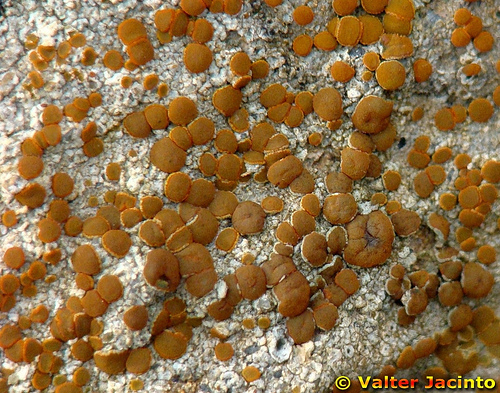
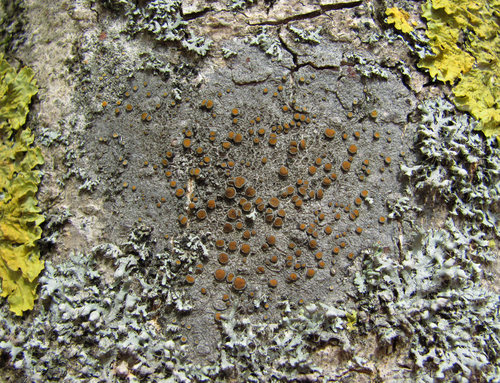
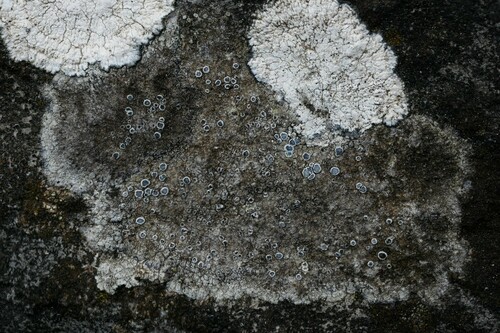
Pyrenodesmia variabilis (Pers.) A.Massal. is a lichen that forms a crustose (crust-like) thallus. Its thallus is most commonly grey to grey-brown, typically thin and somewhat smooth, though it rarely appears white. The thallus is areolate, meaning it is made up of small, rounded, distinct patches. The central region of the thallus is darker than its edges, which may be framed by a black prothallus. This lichen partners with a photosynthetic green alga from the genus Trebouxia as its photobiont.
Its fruiting bodies, called apothecia, grow up to 1 mm in diameter. They are either sparsely scattered or densely crowded across the surface of the thallus, and are sessile, meaning they attach directly without a stalk. Apothecia start out flat, and typically become slightly convex as they mature. They often have a thick, persistent margin that has a grey-blue, powdery (pruinose) appearance. The disc of the apothecia is black, while the epithecium (the layer above the spore-producing asci) is pale. Paraphyses, which are slender filament-like structures located in the hymenium (the spore-producing layer), broaden and become stouter toward their tips, reaching about 3 μm in diameter at the tip.
Each ascus contains eight ascospores of Pyrenodesmia variabilis. The spores are ellipsoid in shape, and measure 14–16 by 7–9 μm. They are polarilocular, with an internal dividing partition (septum) that is 2–3 μm wide, which can sometimes be as long as one-third of the spore's total length. In the potassium hydroxide (K) spot test, the thallus shows no chemical reaction (K–), while the epithecium turns purple when it contacts the chemical (K+ purple).
Pyrenodesmia variabilis grows in nutrient-rich limestone habitats, growing well on both natural boulders and human-made stonework. It is often found on horizontal surfaces such as the tops of chest tombs, and the copings of walls and bridges. It is generally epilithic, meaning it grows on the surface of rocks, but has occasionally been recorded as endolithic, growing inside rocks, under and around rock crystals.
This species is widespread across England and Wales, including the English Midlands, and extends sporadically to Scotland and Ireland. It also occurs in Bulgaria, Greece, Ukraine, and Russia. It is found across the Northern Hemisphere, and reaches as far south as Central America. In Asia, it is distributed in Nepal, and occurs in Iraq and Turkey in Western Asia.