About Pyrausta sanguinalis Linnaeus, 1767
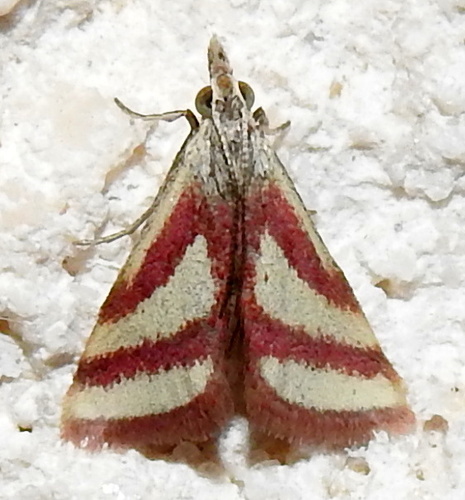
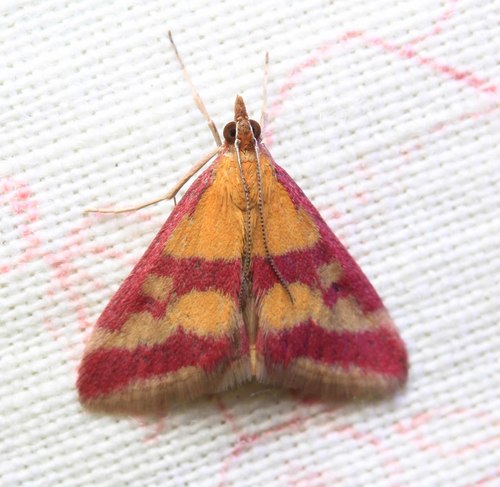
Pyrausta sanguinalis, commonly known as the scarce crimson and gold, is a moth species belonging to the family Crambidae. Carl Linnaeus first described this species in 1767, in the 12th edition of his work Systema Naturae. This moth has a wingspan ranging from 14 to 18 mm. Its forewings are brownish ochreous, with deep yellow basal and dorsal areas, and the disc is mixed with yellow. All markings on the forewings are purple-crimson: there is a streak running along the costa to three-quarters of the wing length, a fascia before the middle of the wing, an oblong discal spot connected above to the costal streak and sometimes connected below to the preceding fascia, and a subterminal fascia. Male hindwings are light grey, becoming darker toward the terminal edge, while female hindwings are plain grey; the middle section of the terminal margin of the hindwings is crimson. The larva is greenish-grey with a reddish tint, has whitish subdorsal and spiracular lines, and a brown head. Adult moths fly from June to August, with flight timing varying by location. Larvae of this species feed on common sage, rosemary, and thyme.