About Pyrausta despicata Scopoli, 1763
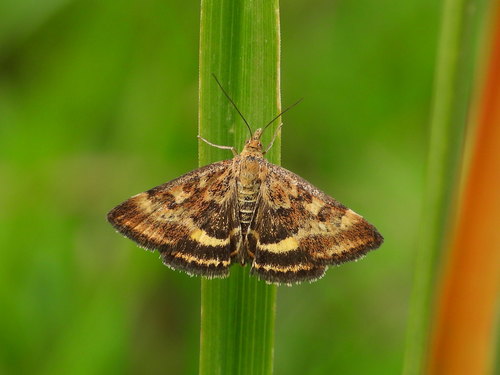
Pyrausta despicata (Scopoli, 1763) has a wingspan that ranges from 14 to 19 mm. Its wings are brown or greyish, with quite variable pale brown markings. The forewings are brownish grey or brown, and are sometimes sprinkled with blackish speckles. The first forewing line is indistinctly pale, or it may disappear entirely. The second forewing line is pale greyish-ochreous, and is often obsolete except on the costa; in males, this line is whitish-ochreous and dilated on the costa. The small orbicular and oval discal spots on the forewings are rather darker than the surrounding wing tissue, and in females these spots are sometimes separated by a pale spot. A pale subterminal streak is present on the forewings in some individuals. For the hindwings, males are grey and females are blackish. A darker discal dot is sometimes present on the hindwings. The curved postmedian fascia and subterminal streak are obscurely ochreous-whitish in males, and whitish-ochreous in females. The larva of Pyrausta despicata is a dull brownish-black colour. Its dorsal line is double and grey, and its spiracular line is dull ochreous. Its spots are black, ringed with grey. The larva's head and second thoracic plate are brown, marked with darker freckles. Depending on location, the adult moth flies from May to September, producing two generations per year. Adults are active during sunshine and at dusk. Larvae feed on Plantago lanceolata and Plantago major. Pyrausta despicata is present across most of Europe. This moth species prefers chalky and limestone habitats.