About Pygarrhichas albogularis (King, 1831)
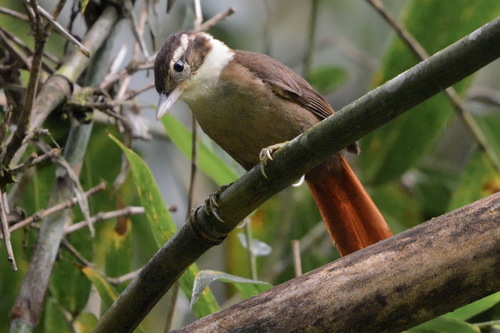
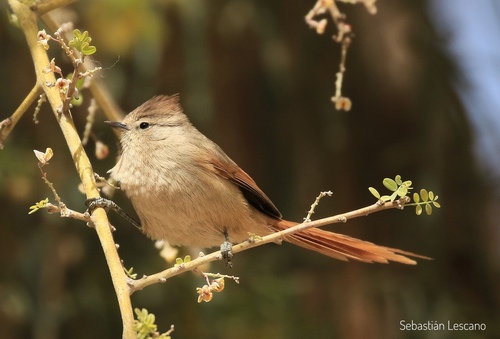
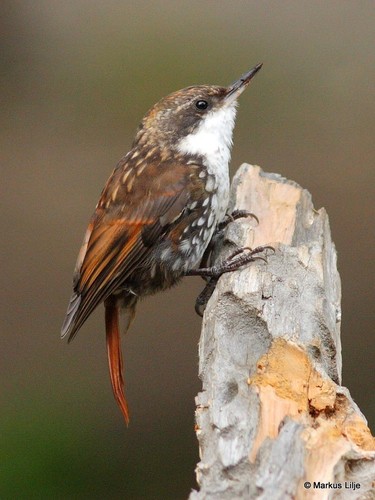
The white-throated treerunner (Pygarrhichas albogularis (King, 1831)) averages 15–16 cm (5.9–6.3 in) in length and weighs between 20–27 grams (0.71–0.95 oz). Its overall appearance and plumage are reminiscent of nuthatches, differing from other species in the Furnariidae family. Measured dimensions include a wing chord of 76–86 mm (3.0–3.4 in), a tail length of 52–65 mm (2.0–2.6 in), and a torso length of 20–23.7 mm (0.79–0.93 in). It has a dark brown iris, a long beak approximately 16–23.8 mm (0.63–0.94 in) long with a slight upward curve: the upper mandible is dark gray, while the lower mandible is whitish-pale gray. Its feet are dark gray, blackish, or brown. The species is easily identified by its white throat, which contrasts with its upper body. Its face is blackish-brown and slightly darker than its dull brown crown. The back is a paler chestnut-brown, which contrasts against the red rump and tail. Wing coverts are dark brown, with red or chestnut brown on feather edges and the tail tip. Primaries are darker, and remiges are black-brown with light edges; inner primaries are marked with a short, light red wing bar. The tail is rounded, with rigid rectrices that have shortened barbs ending in small spines up to 9 mm (0.35 in) long. A large white patch covers the cheek and throat, extending down to the middle of the chest. The rest of the underparts, extending to the undertail coverts, are made of white feathers that are largely bordered with dark brown, creating an irregularly spotted pattern. Adult males and females have identical plumage. Juvenile chicks differ from adults, having an ochre-striped crown and back, and often blackish borders on their throat feathers. This species occurs in central and southern Chile and western Argentina, ranging from Santiago and Mendoza south to Tierra del Fuego. In the southern portion of its range, it is found in the world's southernmost forest on Horn Island. It occurs from sea level up to 1,200 m in elevation, and inhabits forests with large trees, both dense and open, but avoids young forests. The white-throated treerunner favors forests dominated by "false beech" species of the genus Nothofagus. Like a small woodpecker, it forages on tree trunks from mid-height up to the top of the canopy. The species is generally sedentary, but may move erratically outside of the breeding season. Behaviorally, the white-throated treerunner is similar to nuthatches (Sitta spp.); it is a restless bird that moves in jerky patterns and changes direction quickly, and can descend tree trunks head first. It searches the trunks and large branches of old trees, often spiraling around trunks, to find small insects and their larvae in every crevice. It sometimes taps lightly with its bill, much like a woodpecker, or digs larvae out from under bark with its bill. It uses its tail for support while foraging, and often browses moving tail-first along trunks. It explores trunks quickly, and spends more time foraging on smaller branches, searching for prey at the base of leaf petioles. Its overall diet is not well studied, but is known to consist of arthropods, including adult and larval beetles, and diptera. A study conducted in Osorno Province found that the white-throated treerunner forages most often on Coigüe (Nothofagus dombeyi), but also uses Neuquén Roble (N. obliqua), Ulmo (Eucryphia cordifolia), and more generally dead trees, even when other tree and shrub species are available. These foraging preferences may be explained by the bark structure of these trees and the greater abundance of accessible insects. In some locations, particularly on islands without terrestrial predators, the species may also feed on the ground. Outside the breeding season, it may join mixed-species foraging flocks with the thorn-tailed rayadito (Aphrastura spinicauda) and the striped woodpecker (Veniliornis lignarius), and sometimes also with the fire-eyed diucon (Xolmis pyrope), Patagonian sierra finch (Phrygilus patagonicus), and black-chinned siskin (Spinus barbatus).