About Pycnoclavella stanleyi Berrill & Abbott, 1949
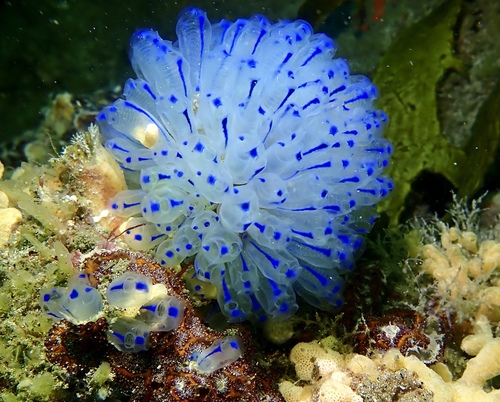
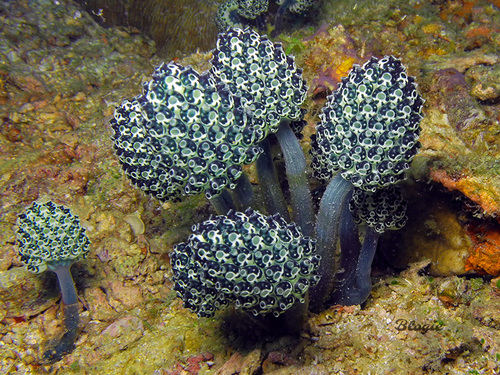
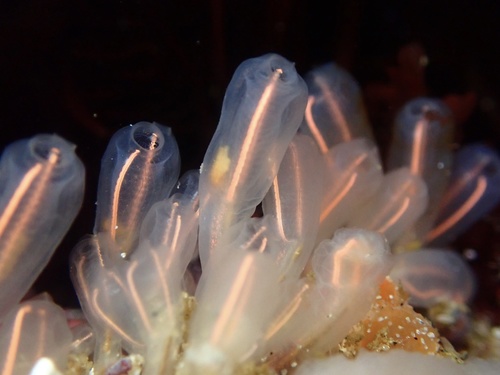
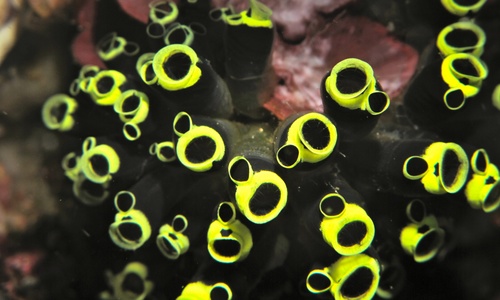
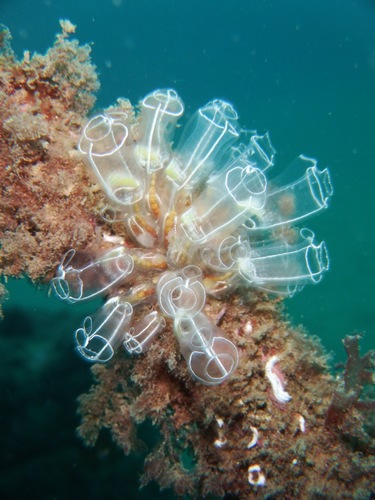
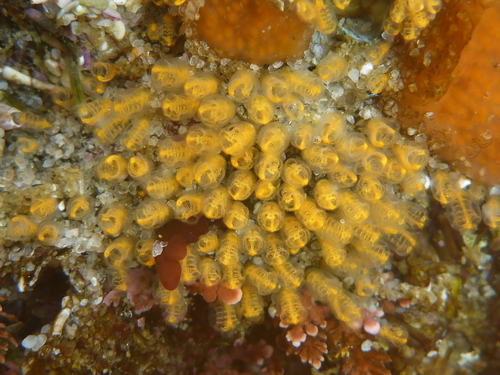
Pycnoclavella stanleyi is a colonial ascidian tunicate, where widely separated individual organisms share a common base. It has a leathery tunic that is typically covered in sand grains. This species can be identified by its seven rows of gill slits and distinctive gold or yellow-orange colored pharynx. This color pattern overlaps with the introduced species Botrylloides violaceus, but B. violaceus grows in chains without clear outer separation between individual organisms. P. stanleyi is a small species, with individual organisms not exceeding 1 centimeter in height. Pycnoclavella stanleyi is found along the Eastern Pacific shoreline, ranging from British Columbia to Baja California. This tunicate prefers shallow water habitats. It grows as an encrusting organism on surf-pounded rocks near sandy bottoms, at depths ranging from 0 to 10 meters. It is often found growing near seaweed holdfasts. Like other ascidians, Pycnoclavella stanleyi can reproduce both sexually and asexually. Asexual reproduction occurs through budding. Sexual reproduction produces tadpole-like larvae, which have an oval body with a long tail. The larval body contains a dark simple eye structure called an ocellus. Unlike the larvae of many other sea squirt species, these larvae do not have an otolith. Like other sea squirts, Pycnoclavella stanleyi is a sessile filter feeder. It draws food particles out of fast-moving water using its pharynx equipped with gill slits. P. stanleyi is one of the tunicate species that sequesters vanadium, and it has vanadocytes circulating in its bloodstream.