About Pycnarmon radiata Warren, 1896
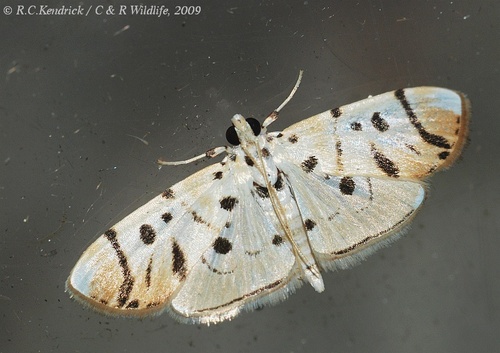
Pycnarmon radiata is a moth species belonging to the family Crambidae. It was first described by William Warren in 1896. This species can be found in China and India. The wingspan of Pycnarmon radiata measures 28 mm. Its forewings are white with a faint ochreous tinge. They have a minute black dot at the base of the costa, a black spot on the median near the base, and another black spot on the inner margin further from the base. There is also a black spot on the costa at one-third of its length, from which the first line runs vertically to the inner margin. A small black dot sits in the cell, with a large black spot at the end of the cell. A black streak runs from below the small dot to the inner margin before the anal angle, and a second black streak runs from below the discal spot to the hind margin above the anal angle. A row of black marginal spots runs along the edge, increasing in size as they get closer to the anal angle. A thick black outer line starts from the costa beyond the two-thirds mark. The hindwings have a large black discal spot, with a smaller black spot closer to the base. They also have a black postmedian line that forms two large curves: one curving around the cell, and the other curving below the cell, ending at a black spot on the inner margin.