About Pycnanthemum muticum (Michx.) Pers.
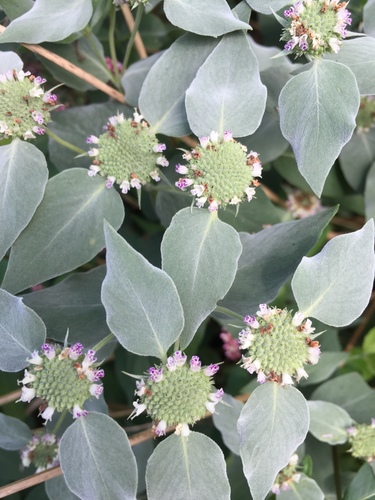
Pycnanthemum muticum is a herbaceous perennial mint that grows 40 to 100 centimeters (16 to 39 inches) tall. Its stems branch frequently: lower branches are short and leafy, while upper branches grow nearly as tall as the main stem. Like other mints, its stems have a characteristic square cross-section. Plants grow upright (erect) and spread via adapted underground stems called rhizomes. The ends of stems are covered in very small hairs. Leaves are larger near the base of the plant, have toothed edges, and attach directly to the stem (sessile). Leaf shape ranges from oblong (rounded rectangular) to ovate-lanceolate (somewhat egg-shaped, tapering to a point). At maximum size, leaves are 4 to 7 centimeters (1.6 to 2.8 inches) long. Leaves have a fuzzy, hairy texture, are gray-green in color, and have very distinct visible veins. This distinct leaf veining, along with the compact shape of its flowering heads, helps distinguish this species from other members of its genus. The flowers of Pycnanthemum muticum are small and densely packed into heads, surrounded by large silvery bracts. Most flower heads grow at the ends of stems, though a few may grow in the axils, the joints where leaves meet stems. The tiny flower petals are pink to white. Flower heads measure 8 to 15 millimeters wide, and bloom from July to September. This plant is intensely fragrant, with a strong scent typical of the mint genus. Colonies expand slowly and are long-lived. This species is found in scattered locations across the eastern and central United States, ranging from Florida to Maine along the Atlantic coast, west as far as Texas and Michigan. It is most common in the Appalachian Mountains of the eastern US, as well as in the eastern half of Pennsylvania, New Jersey, Connecticut, Massachusetts, Vermont, and New Hampshire. To the west, it is also quite common in Arkansas and Louisiana. It grows wild in woods, swamps, thickets, or fields, most often on moist, freely draining soils. Along with plants like wild bergamot and dense blazing star, clustered mountain mint is considered to have high nectar resources for pollinators, and attracts a diverse community of pollinators. Its flowers are especially attractive to butterflies including the gray hairstreak, red-banded hairstreak, eastern tailed-blue, spring azure, and monarch butterfly. NatureServe last reviewed the conservation status of Pycnanthemum muticum in 1985, when it rated the species as globally secure (G5), meaning no significant threats were found and the species is widespread. At the state level, NatureServe rated it as apparently secure (S4) in New Jersey, North Carolina, and Virginia. In Delaware, Georgia, and Ohio it was rated vulnerable (S3). It was rated imperiled (S2) in three states: Mississippi, Missouri, and New York. It was rated critically imperiled (S1) in four states: Kentucky, Michigan, West Virginia, and Vermont. NatureServe considers the species may be extirpated from Maine. Clustered mountain mint is sometimes grown in gardens, especially native plant gardens or gardens planted to support pollinators. Its strong nectar production attracts many types of insects, including bees, wasps, moths, and butterflies. The silvery bracts are more highly valued by gardeners because they last much longer than the flowers themselves. Dried seedheads persist through the winter, providing light cover and nesting material for birds. Mountain mint grows in full sun or partial shade. It prefers moist soils and has very low drought tolerance. The minimum USDA hardiness zone where this plant will survive winter is zone 5. Gardeners propagate clustered mountain mint by division, most often by taking young vigorous growth from the edge of a clump in early spring.