About Pycnanthemum incanum (L.) Michx.
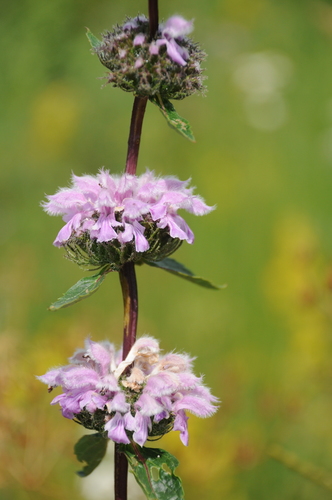
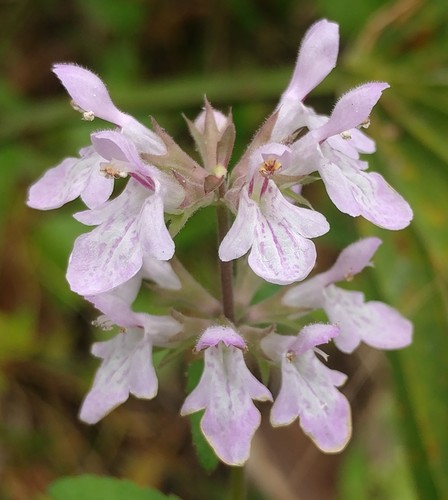
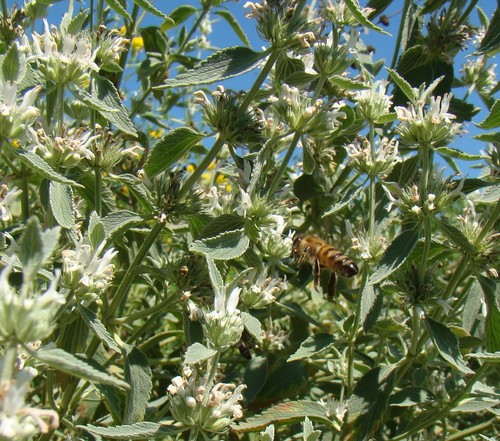
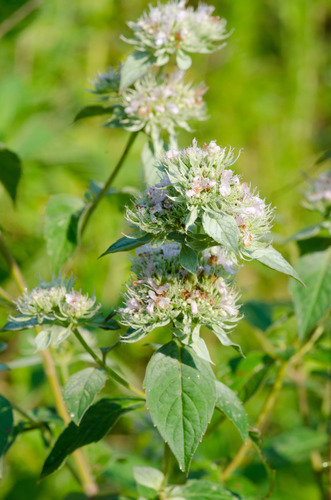
Pycnanthemum incanum (L.) Michx. grows between 2 and 4 feet (0.6 to 1.2 m) tall, and reaches up to 4 feet (1.2 m) wide. Its stems are covered in a soft, whitish down. This plant is a vigorous, often aggressive grower that spreads via long rhizomes. Its white blooms appear from July through September. The genus name Pycnanthemum translates to "dense flower-clusters" in Greek, and the flowers are preferred by butterflies, moths, honeybees, and some wasp species. This species is widespread across the Eastern United States, and extends into Ontario, Canada. It favors rocky, gravelly, or sandy soil, and typically grows in woods, thickets, fields, and on hills. When crushed, the leaves release a strong minty aroma, and they are commonly used to add flavor to teas. Medicinally, this species contains tannin and is classified as an astringent. The Choctaw prepared mashed leaves in warm water for patients to drink, and also poured this mixture over the head to relieve headaches. For chronically sickly patients, the Choctaw mashed leaves in water, had a doctor take a mouthful of the mixture, and blow it onto the patient in three applications each to the head, back, and chest; the patient was then bathed in the medicinal mixture before the next sunrise. The Koasati mashed the plant's leaves in water to treat laziness: the patient would bathe their face in the cold mixture and drink it. To stop nosebleeds, the Koasati would wet the plant and insert it into the nostrils. The roots, boiled together with Black Willow, were drunk to relieve headaches. This species is also known to be a food source for large mammals.