About Puya raimondii Harms
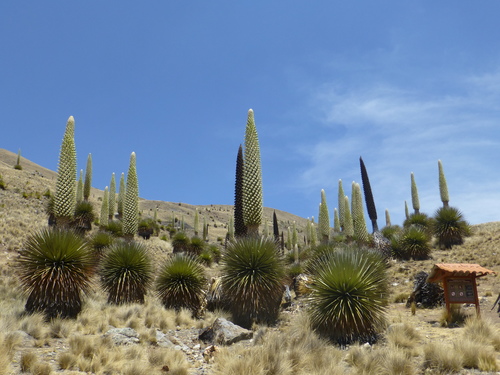
Commonly called queen of the Andes, Puya raimondii Harms is the largest known bromeliad species. Its trunk can reach 4 meters (13 ft) tall and 60 centimeters (2 ft) in diameter, though most trunks are 1 to 2 meters (3.3 to 6.6 ft) tall and are covered in persistent old leaves. At the top of the trunk sits a dense rosette of leaves; each individual leaf is 1–1.25 meters (3–4 ft) long and about 9 centimeters (4 in) wide. Leaf upper surfaces are green, while undersides are covered in small scurfy scales called lepidote scales, which give them a white color. Leaf edges are widely serrated with stiff, dark brown spines that each measure around 1 centimeter long. The plant's inflorescence is typically 4 to 5 meters (13 to 16 ft) tall, and can reach up to 8 meters (26 ft) in height. The short thick stem that supports the flowering stalk is 20 to 40 centimeters (8 to 16 in) in diameter, and only 60 to 90 centimeters (24 to 35 in) tall. At full flowering, the entire plant can reach a maximum height of 15 meters (50 ft), though most mature flowering plants stand between 8.3 meters (27 ft) and 9.5 meters (31 ft) tall. Estimates of the total number of blooms per plant vary: Antonio Raimondi put the number at over 8,000, while Anthony Huxley estimated it at 20,000. Blooms develop over several months, starting in May or June and continuing as late as mid-December, though the full-sized floral spike is formed by October. Individual flowers have 6–8 centimeter long greenish-white petals that often carry a purple tint, which curve to a bluntly pointed tip. Each flower has three petals and three sepals; sepals are lanceolate, spear-head shaped with a pointed tip, and 4 centimeters long. After flowering, seeds ripen and are ready for dispersal by the following July. Once its seeds are mature, the entire large plant dies. Researchers Asunción Cano and co-authors estimate that a single plant can produce up to 12 million seeds. Seeds are held in round to egg-shaped capsules that are 2.5–3 centimeters long. The seeds are very small: including their surrounding edge wing, each seed measures only 3–5 millimeters across. The fruiting stalk is high in resins, so the plant burns very easily. In its native habitat, the species' full reproductive and life cycle lasts 40 to 100 years. One individual cultivated near sea level at the University of California Botanical Garden flowered in August 1986 after only 28 years of growth. This species is monocarpic, meaning it dies after reproducing. Unlike all other bromeliads, it cannot reproduce vegetatively, and relies entirely on seeds to produce new generations. Puya raimondii forms close relationships with pollinating birds. It was once hypothesized to be a protocarnivorous plant, because its spiny fronds can trap birds. Researchers now consider this bird-trapping trait most likely to function as a defense mechanism instead. Puya raimondii is native to the Andes mountains of Bolivia and Peru. It most commonly grows at elevations between 2,400–4,200 m (7,900–13,800 ft), though a small number of individuals have been recorded growing as high as 4,460 m (14,630 ft). It grows on rocky and shrubby slopes across three habitat types: wet Páramo, tropical montane steppe, and humid montane forest. This species has very specific site requirements: it prefers to grow in small, discrete patches even when surrounding terrain appears equally suitable, leading to a patchy distribution of its populations. Despite being a high altitude native species, it has grown successfully at near sea level in temperate climates. The semelparous life history of the queen of the Andes—reproducing a single time then dying shortly after—has evolved independently in very distantly related groups of organisms. Among plants, this monocarpic strategy is very common in short-lived annual and biennial plants, but it is a much rarer strategy for long-lived plants. This trait has evolved in other species that form unbranched rosettes like Puya raimondii. Both hummingbirds and perching birds visit the plant's flowers to feed on nectar. The black metaltail hummingbird (Metallura phoebe) lives in high Andean stands of this species and other puyas, though its nests have only rarely been observed, and none have been found in the crown of Puya raimondii. Two bird species, the black-winged ground dove (Metriopelia melanoptera) and the ash-breasted sierra finch (Phrygilus plebejus), have been observed nesting in the crown of Puya raimondii. This nesting can occasionally be dangerous, as black-winged ground doves sometimes become trapped by the plant's spines. Even birds as large as the American barn owl (Tyto furcata) have died after becoming trapped in puyas.