About Pusa sibirica (Gmelin, 1788)
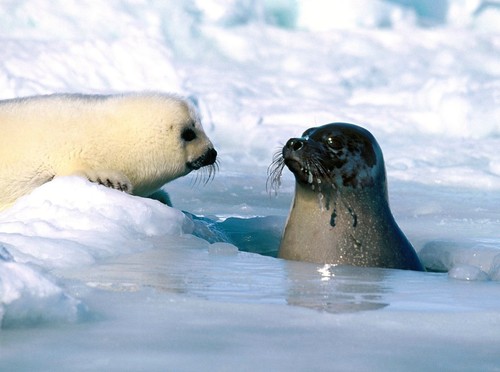
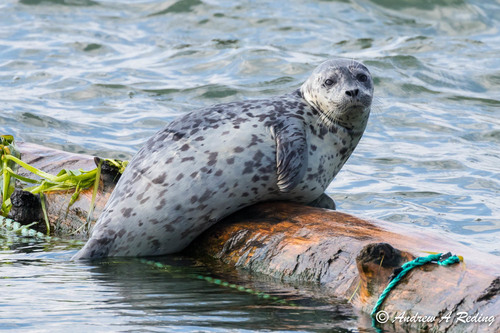
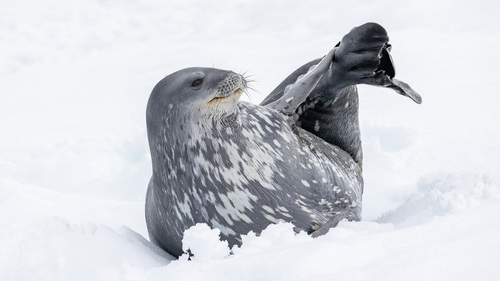
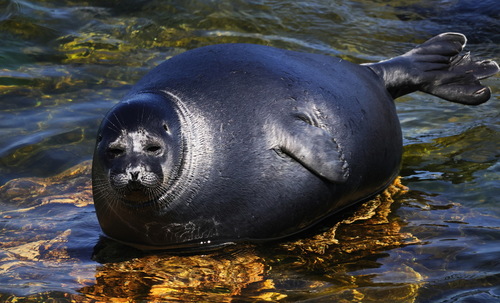
Pusa sibirica (Gmelin, 1788), commonly called the Baikal seal, is one of the smallest species of true seal. Adult Baikal seals typically reach 1.1–1.4 m (3 ft 7 in – 4 ft 7 in) in length, and weigh between 63 and 70 kg (139 to 154 lb). The largest confirmed individual measured 1.65 m (5 ft 5 in) long and weighed 130 kg (290 lb). Baikal seal body weight changes noticeably each year: individuals are lightest in spring, and reach their highest weight in fall, when they are roughly 38–42% heavier than they are in spring. The species shows very little sexual dimorphism, with males only slightly larger than females. Baikal seals have a uniform steely-grey coat on their back, and fur with a yellowish tint on their abdomen. As the coat ages from exposure, it shifts to a brownish color. Newborn pups weigh 3–3.5 kg (6.6–7.7 lb) and measure around 70 cm (2 ft 4 in) long. Pups are born with a coat of white, silky natal fur, which is shed quickly and replaced by a darker coat similar to that of adult seals. Rarely, individual Baikal seals may have spotted coats. The Baikal seal is endemic to Lake Baikal, meaning it lives only in the lake's waters. The specific areas of the lake that Baikal seals occupy change with the season and other environmental conditions. Baikal seals are solitary for most of the year, and individuals sometimes live several kilometers away from other members of the species. In general, higher concentrations of Baikal seals are found in the northern parts of Lake Baikal, as the longer winter there keeps ice frozen for longer, which is preferred for pupping. In recent years, however, Baikal seals have migrated to the southern half of the lake, possibly to avoid hunters. In winter, when the entire lake is frozen over, seals maintain a small number of breathing holes in a given area and stay close to these holes, without interfering with the food supplies of nearby seals. When the ice starts to melt, Baikal seals generally stay along the lake's shoreline.