About Pusa hispida (Schreber, 1775)
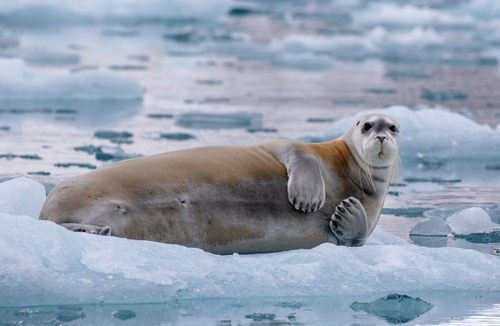
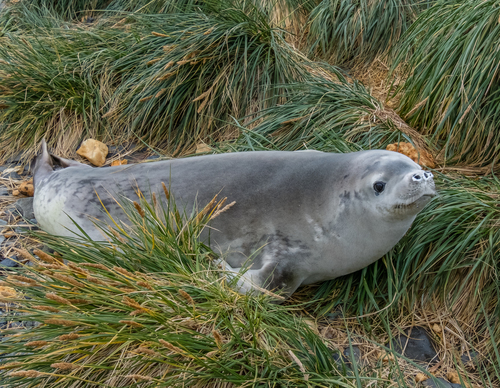
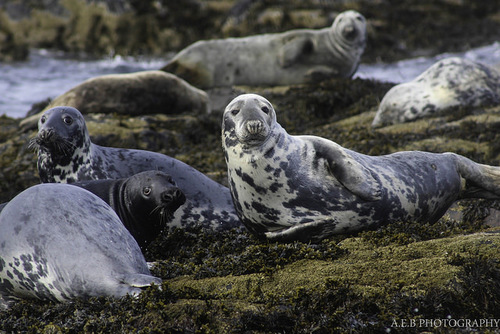
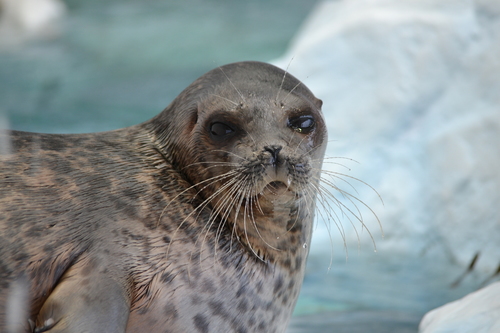
Pusa hispida, commonly known as the ringed seal, is the smallest and most common seal species in the Arctic. It has a small head, a short cat-like snout, and a plump body. Its coat is dark with silver rings on the back and sides, and a silver belly, which gives the species its common name. Adult size and weight vary based on subspecies and individual condition: adult length ranges from 100 to 175 cm (39.5 to 69 in), and adult weight ranges from 32 to 140 kg (71 to 309 lb). The species has an average adult length of about 1.5 m (5 ft) and an average adult weight of 50–70 kg (110–154 lb). While the ringed seal is generally considered the smallest species in the true seal family, several related species, especially the Baikal seal, can reach similarly small body sizes. Its small front flippers have claws over 2.5 cm (1 in) thick, which the seal uses to maintain breathing holes through ice sheets up to 1.8 m (6 ft) thick. Ringed seals have a circumpolar distribution ranging from approximately 35°N to the North Pole, and are found throughout all seas of the Arctic Ocean. Outside of the central Arctic, they also occur in the Baltic Sea, Bering Sea, Hudson Bay, the southern Bering Sea, and range as far south as the Seas of Okhotsk and Japan in the North Pacific. Two subspecies, P. h. saimensis and P. h. ladogensis, live exclusively in freshwater habitats. Across their entire range, ringed seals prefer ice-covered waters, and are well adapted to both seasonal and permanent ice. They tend to favor large ice floes with diameters greater than 48 m, and are most often found in the interior ice pack where sea ice coverage exceeds 90%. They stay in contact with ice for most of the year, and give birth to pups on ice during late winter to early spring. They are found throughout the Beaufort, Chukchi, and Bering Seas, and can range as far south as Bristol Bay in years with extensive ice coverage. From late April through June, ringed seals are distributed across their range from the southern ice edge northward. Preliminary results from 1999 and 2000 May–June surveys of the Chukchi Sea show that ringed seal density is higher in nearshore fast ice and pack ice, and lower in offshore pack ice. Surveys conducted by Frost and Lowry in 1999 found that in the Alaskan Beaufort Sea during May–June, ringed seal density is higher east of Flaxman Island than west of the island. The overall winter distribution is thought to be similar to this spring distribution, and researchers believe there is a net northward movement of seals alongside the retreating ice edge in late spring and summer. This means ringed seals that occupy the Bering and southern Chukchi seas in winter are apparently migratory, though full details of their movement patterns remain unknown. By maintaining breathing holes in ice, ringed seals can use ice habitats that other seal species cannot access.