About Purshia glandulosa Curran
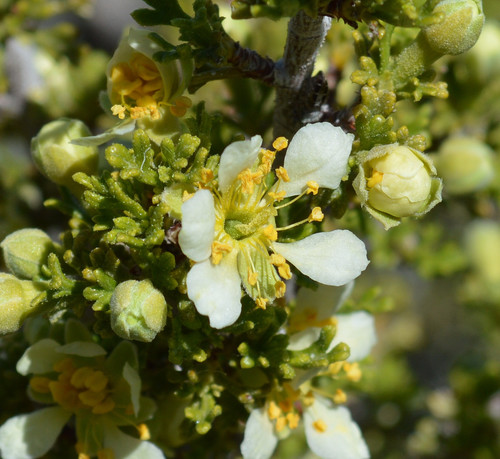
Purshia glandulosa Curran, commonly known as Purshia glandulosa, is an evergreen shrub. It grows up to 4.5 meters (15 feet) tall, often staying smaller based on surrounding environmental conditions. It produces a deep taproot that may reach nearly 5 meters (16 feet) deep into soil, an adaptation that helps it survive drought. Occasionally, this plant forms root nodules that allow it to fix nitrogen. Its flowers are white and scented, and the bloom period falls between February and June, varying by variety. This species can reproduce through seed, layering, and resprouting from its root crown. It can also regenerate from fragments of root severed several feet below ground surface. Regeneration from seed is relatively uncommon, because the seeds have low germination rates, and surviving seedlings do not form easily. Seeds have a very hard outer coat, and germinate more successfully after stratification. Additionally, the plant does not produce seed until it reaches approximately 10 years of age. Purshia glandulosa is endemic to the southwestern United States, where it is found in California, Arizona, southern Nevada, and Utah. It occurs in the Great Basin region, the Mojave Desert, and the chaparral-sagebrush scrub ecotone of the Eastern Sierra Nevada, Tehachapi Mountains, Eastern Transverse Ranges, and Peninsular Ranges. Additional habitats it grows in include pinyon-juniper woodland, conifer forest, and Joshua tree woodland. This species originated through hybridization between Purshia stansburiana (Stansbury cliffrose) and Purshia tridentata (antelope bitterbrush). It is sometimes classified as a variety of Purshia tridentata, and it can hybridize with both of its parent species. This plant can grow on many soil types, most commonly well-drained soils. It can grow in sites with very little soil, such as rock outcrops, and acts as a pioneer species in eroded rock habitats. It cannot tolerate large amounts of water, especially during the summer, and grows best in areas that receive around 10 inches of annual precipitation. It is fire-tolerant, and can easily layer and resprout after its aboveground growth is burned. Its varieties grow at elevations between 500 and 3,500 meters (1,600 to 11,500 feet). Multiple Native American tribes including the Navajo, Klamath, Paiute, and Shoshoni used this plant as a traditional medicinal plant. Navajo people traded the bark of this plant, primarily to mix with animal fur for clothing production, to make bedding material, and to craft infant cradle boards. The plant is good forage for wild ungulates like pronghorn, as well as domestic livestock. It is not deciduous, so its foliage remains available for animal forage during the winter.