About Punctelia subrudecta (Nyl.) Krog
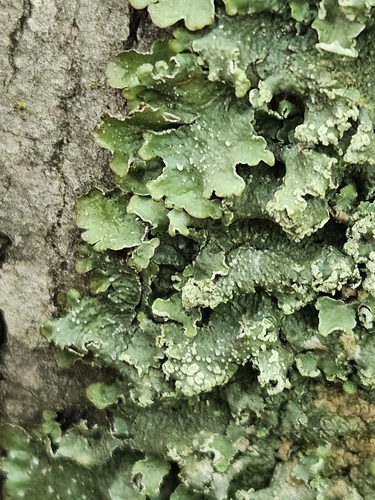
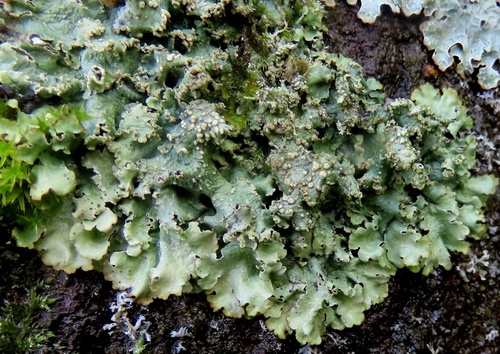
Punctelia subrudecta (Nyl.) Krog has a foliose thallus that typically forms loosened rosettes several centimetres across. Its lobes are relatively narrow, mostly 2–4 mm wide, flat to slightly ridged, and pale grey-green, which darkens when the lichen gets wet. The upper surface is smooth, lacking the shallow pits (scrobiculae) that give P. perreticulata a reticulate appearance, and also lacks the frosty bloom (pruina) that covers lobe tips of P. jeckeri. Minute white pores called pseudocyphellae are scattered across the surface but never occur in large numbers. Vegetative reproduction is the dominant reproductive strategy for P. subrudecta. Powdery reproductive propagules called soredia, which are tiny clusters of algal cells wrapped in fungal threads, break through the outer cortex in distinct patches called soralia. In this species, soralia first develop along lobe edges and secondary lobes; older thallus tissue may also grow scattered laminal soralia, but soredia remain fine and never develop into coarse isidioid granules. The lower surface of the thallus is characteristically pale off-white to light tan, never black, and bears sparse, similarly pale anchoring structures called rhizines; this combination of traits distinguishes P. subrudecta from other genus members that have dark lower thallus surfaces.
Microscopically, the pycnidia of P. subrudecta produce unciform (gently hook-shaped) conidia only 4–6 μm long. This is one of the most reliable diagnostic features of the species, as related North American taxa have much longer, straight conidia. Apothecia (sexual fruiting bodies) are rare; when they do form, they are lecanorine, with a rim matching the colour of the thallus, and may develop sorediate margins. Ascospores of this species are recorded as broadly ellipsoid, measuring 14–17 × 10–12 μm, though most populations reproduce exclusively via soredia. In measurements of 25% of their worldwide P. subrudecta collections, Adler and Ahti found the unciform conidia have a modal length of 4–5.5 μm, with a full range of 3.5–6.5 μm, and are sometimes mixed with a small number of straight conidia. Lobe width in the species ranges from (1–)2–4(–8) mm, which overlaps completely with the lobe width of P. perreticulata, so the authors ruled out lobe width as a useful diagnostic trait.
Chemical spot tests produce a distinctive profile for this lichen: the cortex contains atranorin, which gives a K+ yellow reaction, while the medulla contains high levels of lecanoric acid, which turns pale pink to salmon in the C spot test. This produces a much paler colour than the deep crimson reaction seen in P. borreri. These chemical reactions, paired with the pale lower surface, fine soredia and hooked conidia, create a clear profile that separates P. subrudecta from superficially similar grey sorediate parmelioid lichens. Trace-level chemical variation has been observed in European specimens: thin-layer chromatography of 216 Polish specimens detected atranorin in only around 30% of thalli, even though lecanoric acid was consistently present in the medulla.
Microscopic studies confirm that the photobiont (photosynthetic symbiont) of P. subrudecta is the green alga Trebouxia gelatinosa. At high magnification, the algal cells have an irregular outline and thick cell walls. Each cell contains a multi-lobed chloroplast with a single decolorans-type pyrenoid, a carbon-fixing body pierced by parallel pyrenotubules and surrounded by starch grains called pyrenoglobules. The fungal hyphae either press directly against the algal cell wall, or extend short type-1 intraparietal haustoria into the wall. DNA sequencing of Iberian P. subrudecta material shows that the lichen associates with only a small number of uncommon genetic lineages of T. gelatinosa, two of which it shares with P. borreri. This pattern indicates a selective but locally adaptable symbiosis.
In terms of habitat and distribution, Punctelia subrudecta is predominantly corticolous, growing as tightly attached rosettes on tree bark in temperate and Mediterranean woodlands. Specimens collected from the Iberian Peninsula were found almost exclusively on tree trunks and branches, with only rare collections found on siliceous rock faces that have similar microclimates to bark. Populations have been recorded in Atlantic oak forests and drier eastern Mediterranean mountains, showing the species tolerates a wide range of moisture conditions, as long as atmospheric pollution remains low. Thalli collected from heavily trafficked coastal sites in eastern Spain show pink central necrosis and marginal bleaching, symptoms researchers link to chronic exposure to oxidant and nitrogen pollution.
Polish herbarium data shows the species colonizes a wide range of host trees (phorophytes). It is most frequent on oak (Quercus, 26% of records), and also found on alder (Alnus, 13%), European ash (Fraxinus excelsior, 11%), small-leaved linden (Tilia cordata, 11%), willow (Salix, 10%), and a range of other broad-leaved tree hosts. Rare non-corticolous thalli have even been recorded growing on wood and concrete. Sequence-verified collections confirm P. subrudecta has an essentially Old World distribution, stretching from Fennoscandia south to the Mediterranean, east into Kenya, and at least parts of China and Australasia. All historical records from the Americas are now considered misidentifications.
Within Europe, the species is widespread, documented in at least thirty countries, but has clear regional population bias: for example, in Poland it is largely restricted to the Carpathian and Sudeten foothills, and is scarce in northern and western Poland. Due to ongoing population declines linked to air pollution and removal of roadside trees, P. subrudecta is listed as vulnerable on the Polish Red List and receives full legal protection in the country. National assessments across Europe reflect a broader regional trend: the lichen is legally protected in Poland and Norway, is recorded expanding northwards in areas where sulphur dioxide levels have dropped, and remains threatened where mature roadside trees are felled for road modernisation projects.