About Punctelia stictica (Delise ex Daby) Krog
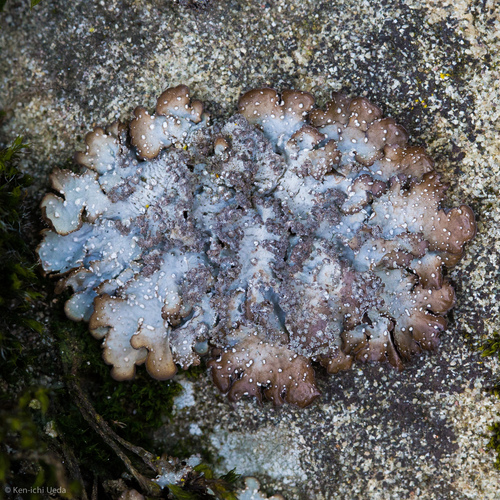
Punctelia stictica (Delise ex Daby) Krog is a lichen with a light to dark brown upper thallus surface. This surface is covered in secondarily sorediate pseudocyphellae, and produces granular to isidioid soredia. These soredia somewhat resemble isidia, are often darkened and solid in appearance, have a cortex, and typically arise from distinct soralia. The underside of the thallus is brown, darkening to black toward the centre. The medulla of this lichen has gyrophoric acid as its major medullary metabolite, and it produces long, filiform (threadlike) conidia. A 1996 study compared morphological and chemical differences between Punctelia stictica and Punctelia colombiana, which is another species with filiform conidia. The study concluded that the two species are closely related but distinct, and are possibly derived from Punctelia jujensis. Punctelia stictica is a widely distributed species with an antitropical disjunct distribution, meaning it occurs at comparable latitudes across the equator but not in the tropics. Although it is primarily found in temperate regions, its range extends into the European boreal zone. It has been recorded in the United States in North America. In South America it occurs in Colombia, Ecuador, Venezuela, Argentina, and Chile, and is very common in Patagonian steppe areas. In Europe, it is known from France and Norway. In Africa, specimens have been collected from Ethiopia and Lesotho. It has also been found in west Greenland. Punctelia stictica most commonly grows on rocks, and grows infrequently on bark or on the ground.