About Punctelia caseana Lendemer & B.P.Hodk.
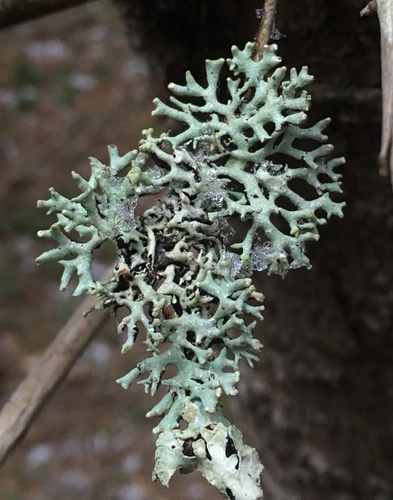
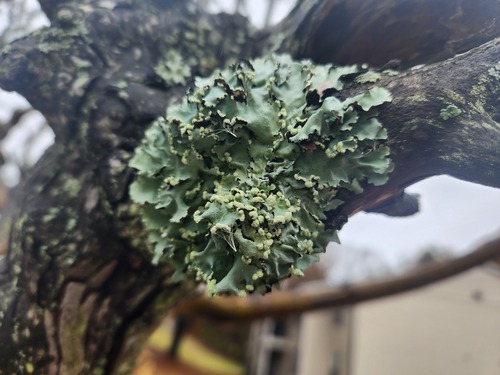
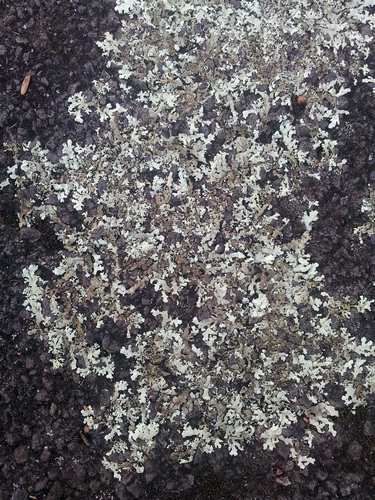
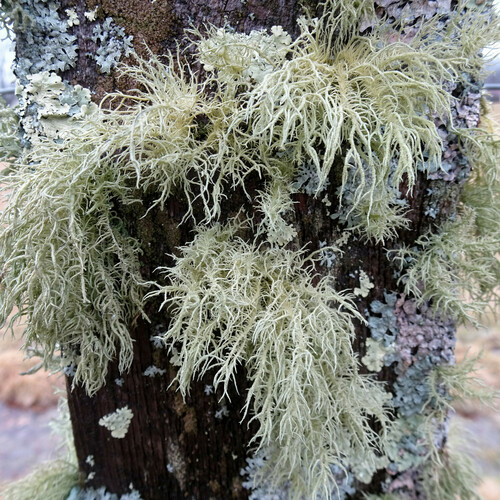
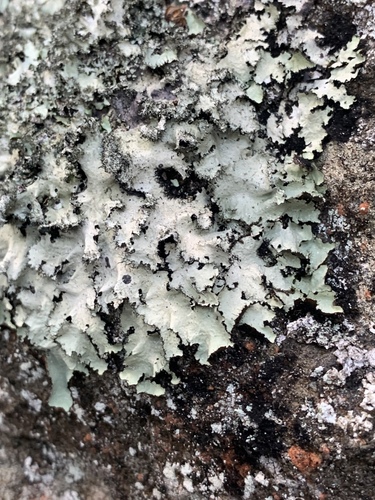
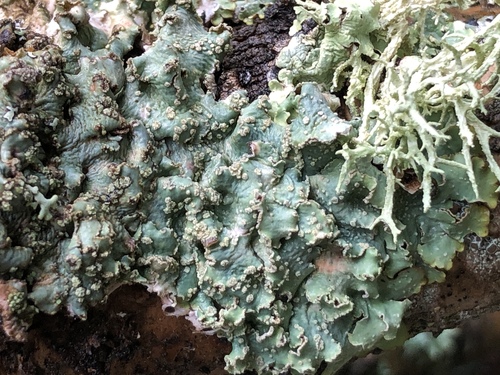
Punctelia caseana, formally named Punctelia caseana Lendemer & B.P.Hodk., has a thallus with a grey-blue upper surface, and a pale to off-white undersurface that is sometimes light brown. The size of the thallus is quite variable, and this variation depends largely on local microhabitat conditions. Many soralia form on the thallus, most of which are located along the margins of the lobes. The soredia it produces are coarse and large. Ascospores made by this lichen are hyaline, with dimensions ranging from 14–17 μm by 10–12 μm. This lichen contains the secondary compounds atranorin, chloroatroanorin, and lecanoric acid. Standard lichen spot tests give the following results: in the upper cortex, reactions are K+ (yellow), C−, KC−, P−, and UV−; in the medulla, reactions are K−, KC+ (red), C+ (red), P−, and UV−. This species can be easily distinguished from Punctelia rudecta, a common North American species, because Punctelia rudecta produces isidia rather than soredia. Two similar species, Punctelia perrituculata and Punctelia subrudecta, share features with Punctelia caseana: both produce medullary gyrophoric acid, and both have a pale lower surface, matching Punctelia caseana. However, both lookalikes have short conidia, and Punctelia perrituculata additionally has a surface texture covered in small round pits or grooves called scrobiculae. In terms of habitat and distribution, Punctelia caseana occurs in the eastern United States, where it grows on many types of hardwood trees, conifers, and occasionally on rotting logs. Its distribution pattern in the eastern US is similar to that of Punctelia subrudecta. The known range of Punctelia caseana was later expanded to include eastern and central Mexico.