About Punctelia borreri (Sm.) Krog
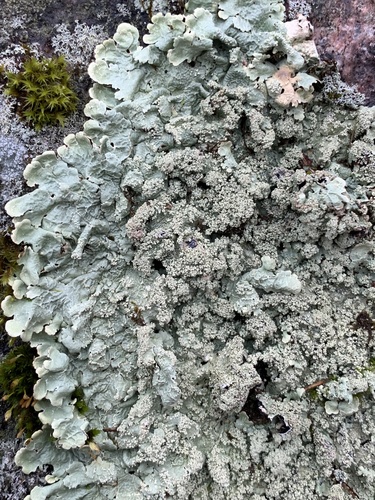
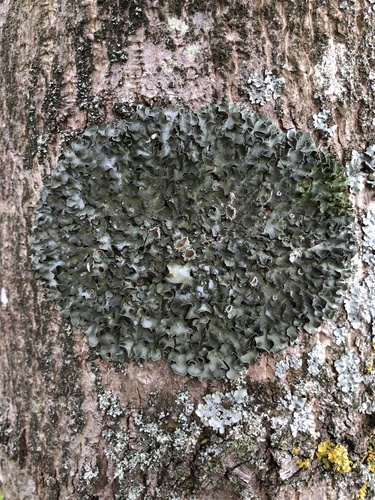
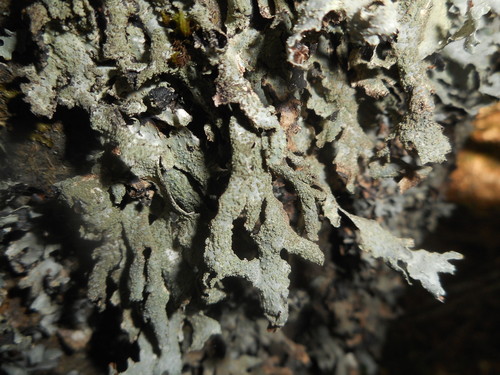
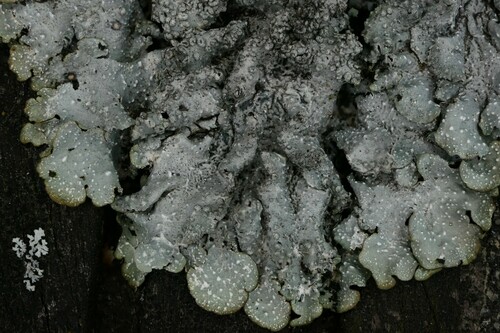
Punctelia borreri has a foliose (leafy) thallus that forms closely attached rosettes, growing up to 10 cm (4 inches) in diameter. The upper surface of the thallus ranges in colour from grey to bluish-grey, greenish-grey, or yellowish-grey; old herbarium specimens turn buff. Thallus margins are sometimes whitish from pruina (a powdery calcium oxalate crystal coating excreted on the thallus surface), and sometimes have a brownish tinge. Pruina is often abundant but not found on all lobes; in fresh specimens, pruina gives lobes a glaucous (dull bluish-green) colour. The thallus surface is smooth and shiny, with some wrinkling near the centre. Thallus lobes are flat or concave, 4–8 mm (0.2–0.3 inches) wide. Pseudocyphellae are small, up to 300 μm wide, roughly circular, and punctate (point-like); they are more prominent towards the thallus periphery, and aggregate closer to the centre in regions containing powdery propagules called soralia. Soralia are dot-like, whitish, distinctly rounded, and arise from small, punctiform pseudocyphellae that often merge together as they age. Soredia are farinose (powdery), becoming more or less granular on older thalli. Sexual propagules called apothecia are rarely produced by this species; when present, they are lecanorine in form, 2–8 mm (0.08–0.3 inches) wide, and have a thalline margin that is often sorediate. Because apothecia are rare, Punctelia borreri is thought to reproduce mostly asexually via soredia or soredia-like vegetative structures called blastidia, which contain both the fungal mycobiont and photosynthetic photobiont, and are produced by yeast-like budding. The lower surface of the thallus is brownish black, and typically darkens towards the centre. This dark colour comes from a brown pigment that can be seen in the cortex in thin thallus sections. Researchers Spier and van Herk have suggested that the underside of the thallus darkens with age, which explains why the oldest part (the thallus centre) is the darkest. Numerous unbranched black or pale brown rhizines, which act as holdfasts to attach the thallus to its substrate, are present on the lower surface. Asci are eight-spored and of the Lecanora-type. Ascospores are broadly ellipsoid, hyaline, and measure 15–18 by 12–15 μm. Pycnidia appear as tiny black spots 25–55 μm wide, immersed in the thallus surface. Pycnoconidia, the asexual propagules produced in pycnidia, are bacilliform to slightly bifusiform (threadlike with a swelling at each end), 4–6 μm long and about 1 μm thick. The photobiont partner of Punctelia borreri is the spherical green alga Trebouxia gelatinosa. In secondary chemistry, Punctelia borreri is defined by the presence of gyrophoric acid and unidentified fatty acids in the medulla, and atranorin and chloroatranorin in the cortex. A study of specimens collected from the Iberian Peninsula found that P. borreri consistently contained lecanoric acid, orcynil lecanorate, and orsellinic acid as minor substances; authors noted that the presence of lecanoric acid in these samples was unexpected. Standard lichen spot tests give the following expected results for P. borreri: upper cortex K+ (yellow), C−, KC−, P−; medulla K−, C+ (pinkish-red), KC+ (pinkish-red). Punctelia borreri most commonly grows on bark, and is occasionally found growing on rock. It has a cosmopolitan distribution, and has been recorded from Africa, Asia, Europe, North America, Oceania, Macaronesia, and South America. In North America, its distribution is largely limited to the west coast, ranging from California to Canada. While it has been reported in Ohio and West Virginia, it is rare in eastern North America. In Mexico, it only occurs in Veracruz. In Australasia, it is widely distributed, reported across eastern Australia and New Zealand; it is fairly common in eastern Australia (including Queensland, New South Wales, and Victoria) but rare in New Zealand. In India, it occurs in subtropical and lower temperate regions at altitudes of 1,500–2,200 m (4,900–7,200 ft). A 2017 record from the Hunza Valley in Pakistan was the first documented occurrence of the species in that country. Before it expanded its range in Europe, Punctelia borreri had a strongly oceanic distribution with scattered occurrences in central Europe. A 2008 checklist of all parmelioid lichens in Europe (updated in 2011) noted that P. borreri had been recorded from 21 European countries and island groups. In Ireland, the lichen usually grows on deciduous trees in well-lit, nutrient-rich areas, such as near farms, beside rivers, along hedgerows, and in gardens or orchards. Punctelia borreri is not particularly selective about the type of bark it uses as a substrate. A Dutch study recorded it growing on Norway maple, birch, European hornbeam, European beech, European ash, northern red oak, linden, elm, and trees in the genera Robinia and Prunus. It can even grow on plastic light fixtures as a substrate, as long as the fixture is suitably enriched by eutrophication, such as when it is used as a resting spot for birds. When the municipal council of Leusden (Netherlands) decided to replace old streetlight plastic lampshades, they found that some of these fixtures, which had been located in an urban, tree-rich environment for 25 to 40 years, were covered with lichens, sometimes completely. In one case, P. borreri covered around 80% of the lampshade's surface, which was notable because the lichen was not recorded in the Netherlands until the 1990s. Before the late 1990s, Punctelia borreri occurred very rarely in the Netherlands; after this time, an increase in its frequency was noted. This population increase followed a decrease in the level of the air pollutant sulphur dioxide. Two other foliose lichen species, Flavoparmelia soredians and Flavoparmelia caperata, saw a similar increase in regional frequency during this period. Similarly, in the Czech Republic, P. borreri was one of several lichen species that recolonized the lichen-impoverished landscape after desulfurization of coal power plants in the early 1990s. Changes to the geographic range and regional frequency of Punctelia borreri have also been linked to rising temperatures recorded in recent decades in central Europe. A 2017 German study that assessed the suitability of various local lichens as bioindicators of climate change noted that P. borreri was very rare in the Rhineland in the 19th century, but has become increasingly common since 2001. For this reason, it is used as an indicator of climate change in Germany. In the Iberian Peninsula, Punctelia borreri had been noted as a mainly coastal species, but it was first reported from the central plateau in 2004, found in Madrid's Parque del Oeste. This occurrence matched the installation of a fine-mist irrigation system designed to maintain constant air relative humidity, plus a decrease in sulphur dioxide air pollution in Madrid; these factors created an environment more similar to the climate of coastal regions of the Iberian Peninsula. Several endophytic fungi (fungi that live within the tissue of plants or lichens) have been isolated from Punctelia borreri thalli. These include Chaetomium globosum, the conidial stage of Hypoxylon fuscum, Nodulisporium hyalosporum, the conidial stage of Spirographa ciliata, and unidentified taxa from the genera Chaetomium, Nodulisporium, Phoma, Thielavia, and Scopulariopsis. Two species of lichenicolous fungi, Nesolechia oxyspora and Pronectria subimperspicua, have been recorded parasitizing Punctelia borreri. Infection by Pronectria subimperspicua creates discoloured areas on the host thallus. Punctelia borreri has been used in traditional Chinese medicine as a purported remedy for a range of ailments, including chronic dermatitis, blurred vision, uterine bleeding, external injury bleeding, sores, and swelling. For use, a decoction is drunk, or dried powdered lichen is applied directly to the affected area. Laboratory tests using the disk diffusion method have shown that ethanol extracts of P. borreri have antimicrobial effects against the bacteria Xanthomonas campestris and Staphylococcus aureus. In a study investigating the potential of several lichens as antidiabetic agents, P. borreri was noted for its in vitro ability to inhibit α-amylase, a key enzyme in carbohydrate digestion.