About Punctelia bolliana (Müll.Arg.) Krog
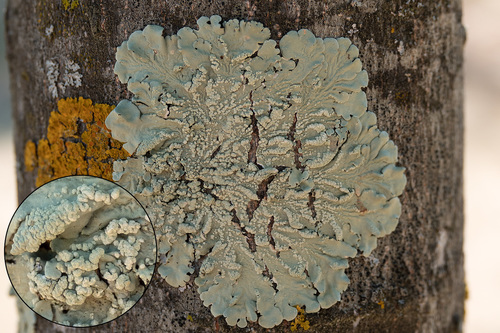
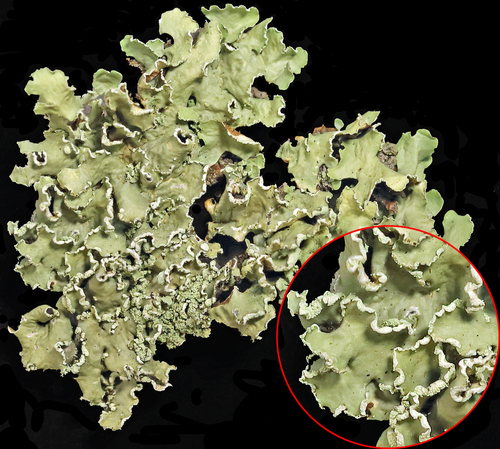
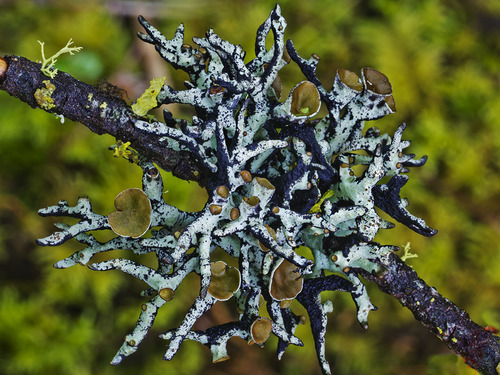
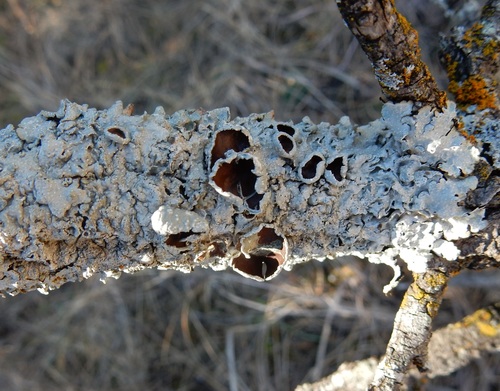
Punctelia bolliana (Müll.Arg.) Krog has a bluish-grey thallus made up of lobes 2–6 mm (0.08–0.24 in) wide. With age, the thallus surface typically becomes folded and wrinkled, and develops small lobules along its edges and across its surface. Isidia and soralia are not present; the lobules are thought to act as vegetative propagules, though they are described as "robust and not easily fragmenting". The underside of the thallus is pale tan, with pale rhizines. Apothecia are often abundant, though they are absent in some cases; they measure 3–15 mm (0.1–0.6 in) in diameter, and have brown, convex or convoluted discs. Pycnidia are usually abundant, appearing as tiny light brown to black dots on the thallus surface. The medulla is white, with a continuous algal layer. The presence of both lobules and apothecia is quite variable; Egan and Lendemer have noted that the abundance of one appears to be somewhat inversely proportional to the abundance of the other. The ascospores of this species are translucent, roughly ellipsoid in shape, and measure 11–15 by 5–9 μm. The conidia are short and rod-like, measuring 4–5 μm long. Standard chemical spot tests can help identify Punctelia bolliana, or distinguish it from other Punctelia species. In the medulla, spot test results are PD−, K−, KC−, and C−; in the upper cortex, results are K+ (yellow), C−, KC−, and P−. This lichen contains the secondary chemicals protolichesterinic acid and lichesterinic acid in the medulla, and atranorin plus minor amounts of chloroatranorin in the cortex. Characteristics that define Punctelia bolliana and separate it from other members of its genus are: absence of soralia and isidia; a brown lower thallus surface; fatty acids in the medulla (C−); hook-like (unciform) conidia; and ascospores measuring less than 20 μm. Molecular phylogenetic analysis confirms it is closely related to Punctelia appalachensis, a North American species that also has fatty acids as its main medullary component. In terms of habitat and distribution, in the United States, Punctelia bolliana occurs in central and northeastern parts of the country, and is absent from most of the southeast. Its range extends north into the Canadian province of Ontario. It grows on tree bark in open woodlands. Recorded host tree species include deciduous trees Quercus alba, Quercus macrocarpa, Quercus rubra, Carya ovata, Juglans nigra, Gleditsia triacanthos, and Populus deltoides; it has also been found growing on conifers Pinus strobus and Pinus sylvestris. It has been reported from lichen surveys in the US states of Iowa, Wisconsin, Illinois, Nebraska, New York, Minnesota, and Alabama. In 2021, the species was reported as new to Connecticut; this record is counted among the first reported cases of lichen introduction to North America via import of ornamental trees. It is widely distributed in northern and central Mexico, and has also been recorded from cloud forest remnants in Veracruz.