About Pulveroboletus ravenelii (Berk. & M.A.Curtis) Murrill
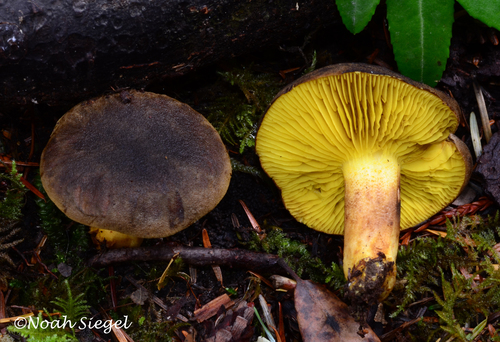
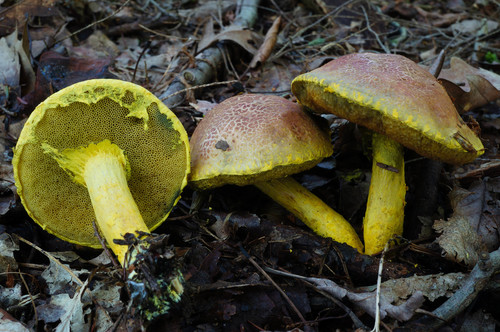
The cap of Pulveroboletus ravenelii is rounded to convex when young, becoming flattened with age, and reaches a diameter of 1–10 cm (1⁄2–4 in). Its margin curves inward in young specimens, and usually retains hanging remnants of the partial veil. The cap surface is dry, initially covered in fine particles; over time it develops fine pressed-down hairs or small scales, and mature caps typically develop fine cracks or wrinkles. The cap color is bright yellow when young, fading to orange-red to brownish red with age. The flesh is white to pale yellow, and when cut, it slowly stains pale blue, then changes to dingy yellow to pale brown. Descriptions of the flesh vary: taste is either indistinct or bitter, and odor is reported to be similar to hickory leaves. The pore surface is bright yellow when young, turning dingy yellow to grayish brown as it ages. When bruised or injured, the pore surface stains greenish blue then grayish brown. The pores are angular to nearly circular, numbering 1–3 per millimeter. The tubes that make up the pore surface are 5–8 mm (1⁄5–1⁄3 in) deep. The yellow stem is 4.5–14.5 cm (1+3⁄4–5+1⁄2 in) long, 0.6–1.6 cm (1⁄4–3⁄4 in) thick, and can be roughly equal in width along its length, tapered, or thicker near the base. It is solid (not hollow), and above the base, its surface is covered in tiny pressed-down hairs. The partial veil is also bright yellow, with a cottony and powdery texture, and remains as a ring on the upper part of the stem; in some specimens, it blends gradually into the stem surface and becomes hard to see. There is white mycelium at the base of the stem. Pulveroboletus ravenelii produces an olive-grey to olive-brown spore print. Its spores are elliptical to oval, smooth, and measure 8–10 by 4–5 μm. The hyphal tissue in the hymenophore is inamyloid and bilateral, meaning it diverges downward from the cap flesh toward the hymenophore edge, away from a central strand. The tubes have scattered cystidia on their walls (pleurocystidia) and abundant cystidia on their edges (cheilocystidia). The hyphae of the cap cuticle are arranged as an ixotricodermium: they are long and typically multi-celled, with erect hyphae embedded in a gelatinous matrix. Clamp connections are not present on the hyphae. Fruit bodies of Pulveroboletus ravenelii grow on the ground singly, scattered, or in groups in woods under conifers. Its preferred mycorrhizal plant hosts are pine, hemlock, and rhododendron. Fruiting occurs from July to October, and is later on the North American West Coast. In North America, it is distributed from eastern Canada south to the Gulf of Mexico, and west to Texas, Michigan, and California. The species was reported from a Mexican beech (Fagus mexicana) forest in Hidalgo, Mexico in 2010. It has also been recorded in Costa Rica and Colombia. In Asia, it has been found in Indonesia and China. It has also been recorded in northeast Australia. Pulveroboletus ravenelii mushrooms are edible. In traditional Chinese medicine, they have been used to treat lumbago, numbness in limbs, and as an antihemorrhagic agent. Bioactive compounds isolated from its fruit bodies include pulveravin A, pulveravin B, vulpinic acid, and pulverolide. The mushrooms are also used in mushroom dyeing, and produce yellow, gold, greenish yellow, orange, or olive colors depending on the mordant used.