About Pultenaea villosa Willd.
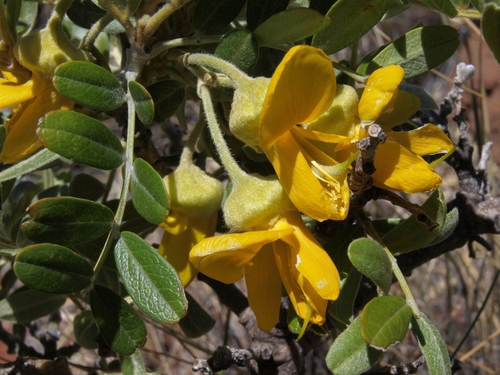
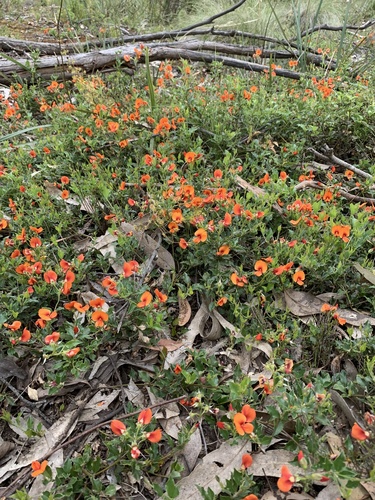
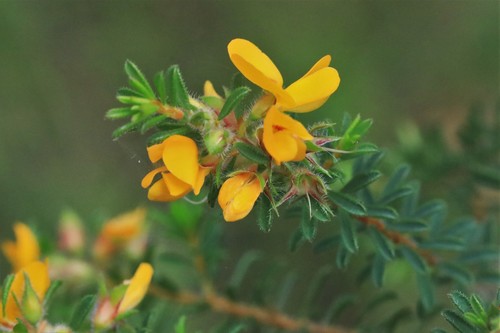
Pultenaea villosa Willd. is an erect, sometimes prostrate shrub, that typically reaches 0.25–2.5 m in height and up to 3 m in width. It has softly-hairy foliage, and sometimes produces weeping branches. Its leaves are arranged alternately, and range in shape from narrow elliptic to linear, oblong, or club-shaped. Most leaves are 3–10 mm long and 1.5–3.0 mm wide, with 1–4 mm long stipules that lie pressed against the stem at the leaf base. The flowers are 5–12 mm long, arranged in small groups near the ends of branches. Each individual flower grows from a 1–4 mm long pedicel. Sepals are 3.5–11 mm long, with bracteoles 3.4–5.3 mm long that are usually attached to the sepal tube. The standard petal is yellow to orange with reddish brown lines and 8.2–10.3 mm long. The wing petals are yellow to orange and 8.2–9.2 mm long, while the keel petal is reddish-brown and 7.6–8.7 mm long. Flowering occurs mainly from August to November, and the fruit is an inflated pod 5–6 mm long. This species, commonly called hairy bush-pea, grows in forest, heathland, grassland and coastal dunes in south-east Queensland, and on the coast and Northern Tablelands of New South Wales. In horticulture, this "eggs and bacon" pea is one of the easier pultenaeas to grow in gardens. It can be propagated from seed or cuttings, and grown as a specimen plant or in informal hedges. It prefers moist soil in a partly sunny position. It is frost hardy and produces attractive reddish new growth.