About Pultenaea procumbens A.Cunn.
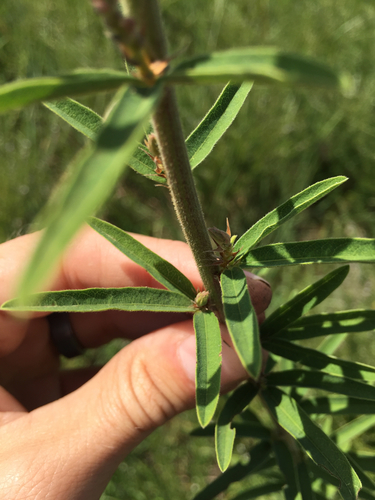
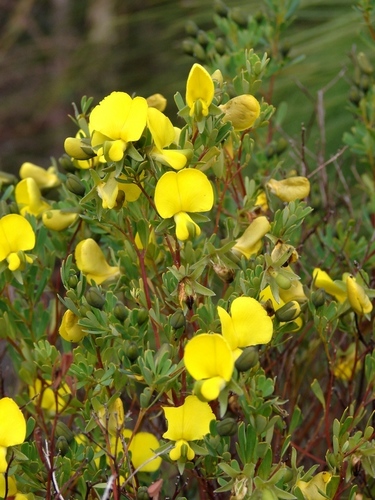
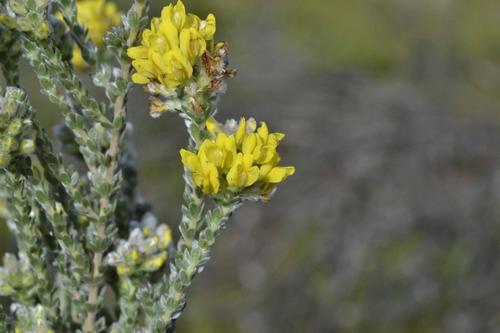
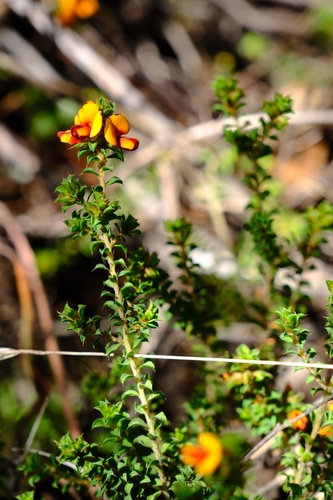
Pultenaea procumbens A.Cunn. is a low-lying or spreading shrub that usually grows to a height of less than 1 metre (3 feet 3 inches). Its young stems are covered in hairs. Leaves are arranged alternately, and are either lance-shaped or rhombic. Each leaf is 4–10 mm (0.16–0.39 in) long and 1–4 mm (0.039–0.157 in) wide. At the base of each leaf are tapering, lance-shaped stipules that are 3–4 mm (0.12–0.16 in) long. The edges of the leaves curve strongly downwards, and each leaf tip ends in a sharp point. Flowers are arranged in dense, leafy clusters of more than three at the ends of branches. Each flower is 7–9 mm (0.28–0.35 in) long, and sits on a pedicel 1.5–2.0 mm (0.059–0.079 in) long. The sepals are 5–7 mm (0.20–0.28 in) long and joined at their base, and lance-shaped bracteoles 4–5 mm (0.16–0.20 in) long are attached to the sepal tube. The standard petal ranges from yellow to red and is 7–8 mm (0.28–0.31 in) wide, the wing petals range from yellow to orange, and the keel petal is red. Flowering occurs mainly from October to November. The fruit is an egg-shaped pod around 5 mm (0.20 in) long. This species, commonly called heathy bush-pea, grows in forest and heath habitats. It is found in New South Wales south from the Nandewar Range, through the New South Wales tablelands and South West Slopes, and the Australian Capital Territory, to northern and eastern Victoria. It occurs in scattered locations, most often on rocky hillsides.