About Pultenaea linophylla Schrad. & J.C.Wendl.
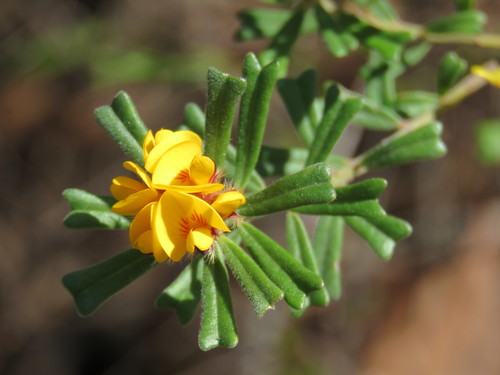
Pultenaea linophylla, commonly known as halo push-pea, is an erect or prostrate shrub that usually grows 0.4 to 1.0 meters (1 foot 4 inches to 3 feet 3 inches) tall. It has wiry, spreading branches. Its leaves are linear to elliptic or wedge-shaped, between 4 and 14 millimeters (0.16 to 0.55 inches) long and 2 to 4 millimeters (0.079 to 0.157 inches) wide. The leaf bases have dark brown, triangular to lance-shaped stipules that measure 1.0 to 1.5 millimeters (0.039 to 0.059 inches) long, and the upper leaf surface is darker than the lower surface.
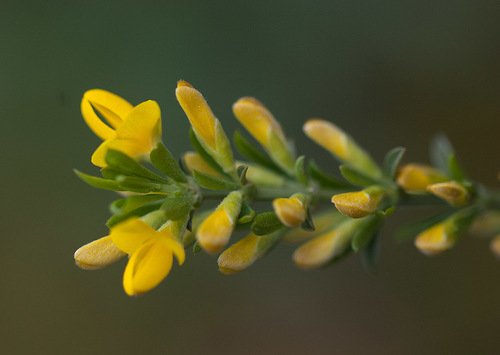
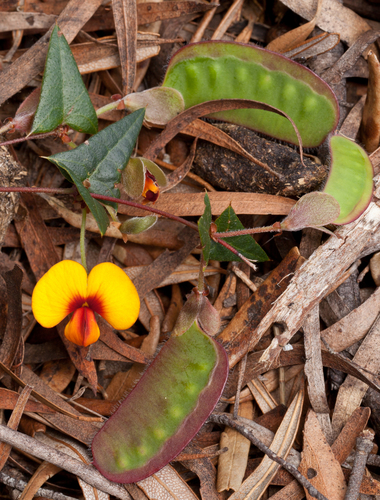
Flowers of this species grow in groups of four to six at the ends of short branches, and each flower is 6 to 10 millimeters (0.24 to 0.39 inches) long, on a 0.5 to 1.0 millimeter (0.020 to 0.039 inches) long pedicel. At the base of the flowers are overlapping narrow egg-shaped to round, three-lobed bracts that are 2 to 4 millimeters (0.079 to 0.157 inches) long. The sepals are 3 to 6 millimeters (0.12 to 0.24 inches) long and covered in dense hairs, with linear to egg-shaped, three-lobed bracteoles 1.5 to 3.5 millimeters (0.059 to 0.138 inches) long attached to the side of the sepal tube. The standard petal is yellow to orange and 5 to 6 millimeters (0.20 to 0.24 inches) long, the wing petals are yellow to red, and the keel petal is red to purple. Flowering can occur in most months of the year, but peaks from September to October. The fruit is a flattened, hairy pod that is around 6 millimeters (0.24 inches) long.
This species grows in forest and heath habitats, with a range extending from south-eastern Queensland, through the coast and tablelands of New South Wales, to eastern Victoria.