About Pultenaea humilis Benth.
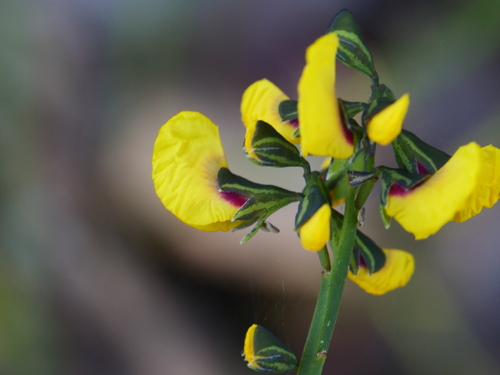
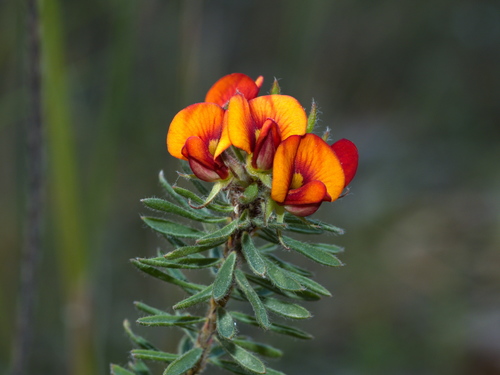
Pultenaea humilis, commonly known as dwarf bush-pea, is a spreading, often low-lying or prostrate shrub. It typically reaches an overall height of around 20 to 80 cm, with 15 to 30 cm long branches that are hairy when young. Its leaves are arranged alternately, are elliptic to lance-shaped with the narrower end oriented towards the base. Individual leaves measure 4 to 16 mm long and 1.0 to 4.5 mm wide, with lance-shaped stipules 1 to 3.0 mm long at the leaf base. Leaf edges curve upwards, and the upper leaf surface is paler than the lower surface. Flowers are arranged singly in leaf axils, forming clusters near the ends of branches. Each flower is 10 to 13 mm long, grows on a pedicel around 0.5 mm long, and has linear to triangular bracteoles 6.5 to 8 mm long attached to the side of the sepal tube. The sepals measure 7 to 11 mm long; the standard petal is yellow to orange with a red base, and is 8 to 10 mm wide, while the wing petals are yellow to red and the keel is yellow to reddish-brown. Flowering takes place from October to December, and the resulting fruit is an egg-shaped pod 4 to 5 mm long. This species grows in heath, woodland, and forest. It occurs in scattered populations on the south-western slopes of New South Wales, and in the northern midlands of Tasmania. It is widespread and relatively common in central and western areas on and south of the Great Dividing Range in Victoria.