About Puffinus bulleri Salvin, 1888
Adult Size
Adults of this species, Buller's shearwater, measure 46–47 cm (18–19 in) in length, have a 97–99 cm (38–39 in) wingspan, and weigh 342–425 g (12.1–15.0 oz).
Upperside Coloration
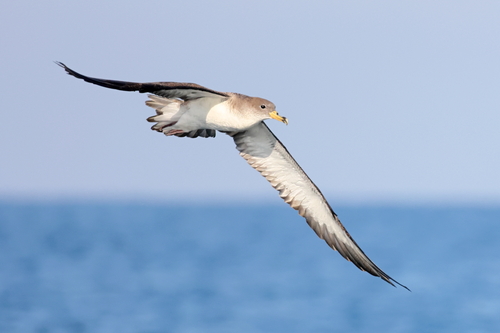
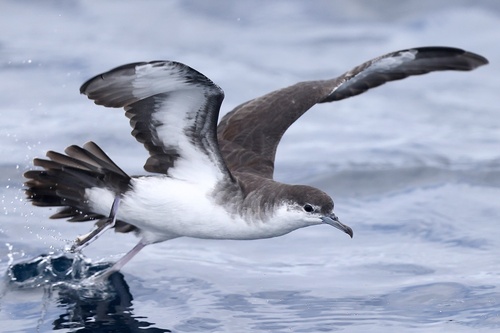
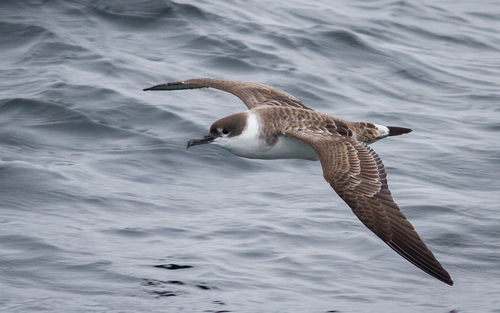
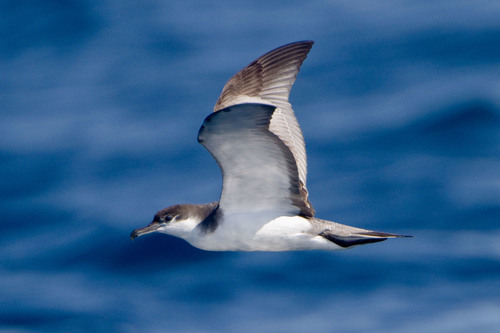
The upperside of Buller's shearwater is bluish grey. A blackish stripe extends from the tertiary remiges to the primary wing coverts, and the primary remiges are also blackish.
Wing Pattern Details
These two black areas do not meet on the hand; the area between them is fairly light grey, and may appear almost white under bright light. When the bird faces upward, this pattern creates the impression of a broken black "M", with interspersed light grey areas.
Underside and Head Coloration
The underside is bright white; on the head, the upperside's grey extends down to eye height, and the white cheeks may stand out noticeably, just like in smaller shearwaters of Puffinus sensu stricto.
Bill, Iris and Tail Features
The rectrices are blackish, and the tail is wedge-shaped; the bill and irises are dark.
Juvenile and Nestling Plumage
Fledged juveniles already have the same colouration as adults, while nestlings are covered in grey down feathers.
Field Identification Characteristics
Compared to other shearwaters, this species is unusually easy to identify at sea due to its combination of considerable size and the distinctive M-shaped banding pattern on its upperside while flying. This pattern is unique among its genus, and is more similar to that of some gadfly petrels (Pterodroma), prions (Pachyptila) and their relative the blue petrel (Halobaena caerulea).
Size Comparison to Similar Species
All of these similar species are much smaller, reaching roughly two-thirds of Buller's shearwater's length and wingspan, and less than half its bulk.
Habitat and Migratory Range
Like other Ardenna shearwaters, this species is pelagic, and is a transequatorial migrant that ranges across most of the Pacific Ocean outside of the breeding season.
Subarctic and Subantarctic Occurrence
While it occurs in subarctic waters off Kamchatka and the Aleutian Islands, it has not been documented in the subantarctic Pacific; however, this apparent absence may simply be due to a lack of study opportunities in the large islandless region south of the Polynesian Triangle.
Americas Coastline Distribution
It is fairly common far off the west coast of the United States during late summer and early autumn, and can generally be observed not far from land along the entire temperate and tropical coastlines of the Americas.
Melanesia and Micronesia Occurrence
Its general absence from most of Melanesia and western Micronesia – an area with considerable human settlement and sea traffic – is therefore likely genuine; only isolated records, such as those from the Marianas, Palau, and Yap, exist from areas west and southwest of the Marshall Islands.
Vagrant Atlantic Record
One vagrant individual has also been recorded in the Atlantic, offshore of New Jersey, United States.
Diet Composition
Buller's shearwater feeds mainly on fish, squid, and crustaceans such as the krill Nyctiphanes australis.
Feeding Association Behavior
It will occasionally follow ships, including fishing trawlers, and may join mixed-species feeding flocks.
Feeding Depth and Method
It catches food mostly no deeper than a head's length below the surface. It typically picks food up with only its bill, often while flying, or briefly inserts its entire head while swimming.
Diving Behavior
It does not often dive either out of flight or in a plunge from the water's surface.
Breeding Colony Location
It is a colonial nester, and breeds predominantly on Tawhiti Rahi and Aorangi, the main islands of the Poor Knights group offshore of northern New Zealand.
Nest Site Preferences
This bird nests in burrows, rock crevices, or under tree roots, and prefers densely forested slopes.
Smaller Colony Habitat
It may also breed in broken rock on treeless stacks or cliffs, and most smaller colonies – located on smaller Poor Knights islands between the main islands and off the southeast of Aorangi – have this habitat type.
Isolated Simmonds Islands Breeding Record
A single breeding pair was observed on the Simmonds Islands in 1980, but this appears to have been an isolated event.
Breeding Season Timing
The breeding season starts in October and lasts for almost half a year.
Incubation Details
A single egg is incubated for around 51 days, with parents switching between incubation and feeding about every 4 days.
Fledging Period Estimate
Time to fledging is not well documented, but by analogy with Buller's shearwater's close relatives it is assumed to be around 100 days.
Historical Human Use and Predation
In the past, Buller's shearwater was heavily used as a food source by Māori, and on Aorangi it experienced massive predation by feral pigs. By the late 1930s, its population on Aorangi had crashed to just 100–200 pairs.
Population Recovery
Pigs were removed from the island in 1936, and the shearwater population recovered, reaching 200,000 pairs again by the early 1980s, and approaching the island's carrying capacity by the end of the 20th century.
Historical Conservation Status
Colonies on Tawhiti Rahi and the smaller islets supplied individuals to repopulate Aorangi throughout this process, and Buller's shearwater was never considered at imminent risk of extinction.
Current Population Size
It is currently a very abundant bird, with an estimated total world population of 2.5 million individuals.
IUCN Vulnerability Rationale
Because it is not known to breed on any larger islands in the region outside the Poor Knights Islands, the IUCN classifies it as vulnerable: a single localized catastrophic event could eliminate the entire species.