About Pueraria montana (Lour.) Merr.
Pueraria montana (Lour.) Merr., commonly known as kudzu, is a seasonal perennial climbing vine. Where vertical surfaces such as trees, cliffs, or walls are available, it climbs to great heights; it grows as ground cover in areas without suitable vertical surfaces. It has tuberous roots and dark brown rope-like stems that can reach 20 m (66 ft) in length. The vine grows up to 20 metres (66 ft) per year and can reach a total height of 30 metres (98 ft). Its young herbaceous stems are noticeably hairy.
This species is native to East Asia, primarily the subtropical and temperate regions of China, Japan, and Korea. It produces trifoliate leaves made of three leaflets; each leaflet is large and ovate, with two to three lobes, and has hairs on its underside. It is able to fix atmospheric nitrogen, which can supply up to 95% of the leaf nitrogen the plant needs when growing in poor soils.
Nodes along the vines are points where new stems or tendrils can grow to help the vine attach to structures for support. As a twining vine, kudzu uses stems or tendrils that grow from any node on the vine to attach to and climb most surfaces. Nodes can also root when they come into contact with soil, anchoring the vine more firmly to the ground. Its tuberous roots have high starch and water content. Because kudzu is a twining plant, it allocates less carbon to building woody stems and more carbon to root growth, which aids root development. Roots can make up as much as 40% of the plant's total biomass.
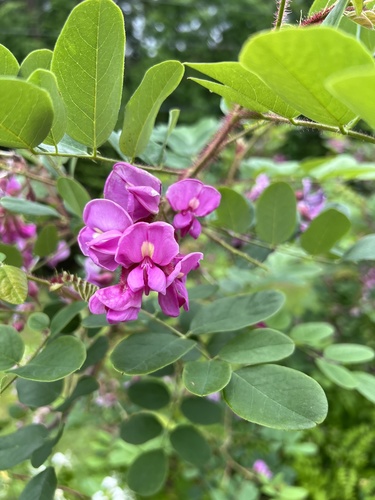
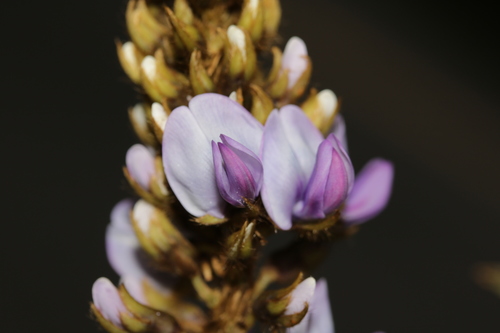
Its flowers are reddish-purple and yellow, fragrant, and similar in shape to pea flowers. They are around 20–25 millimetres (3⁄4–1 in) wide, and grow in elongated racemes around 20 centimetres (8 in) long produced at leaf axils. The flowering period runs from July to October. The fruit is a flat hairy pod around 8 centimetres (3 in) long that holds three seeds.
Kudzu's main method of reproduction is asexual vegetative spread (cloning), enabled by its ability to root wherever a stem touches soil. For sexual reproduction, kudzu depends entirely on pollinators. While kudzu prefers forest regrowth areas and edge habitats with high sun exposure, it can survive in both full sun and partial shade. These growth traits made kudzu popular as an ornamental plant for shading porches in the Southeastern United States, but they also allowed it to become a "structural parasite" across the southern US. When left untreated, kudzu can envelop entire structures, leading to it being called "the vine that ate the south".
Kudzu is described as a "quasi-wild" species. It has been farmed and selectively bred by humans for thousands of years in its native range, but cultivated strains have never become isolated from wild populations. This has led to ongoing genetic exchange between wild and farmed kudzu, resulting in a diverse, vigorous gene pool strongly shaped by human interaction with the plant. Kudzu's main uses include food, fiber, and medicine; it is also used to make paper, for basketry, and as a food source for livestock.
The starchy kudzu root has been used as food in China since before 540 CE, with specific cultivars bred for this use, and has historically sustained Chinese people during famines. Kudzu starch is used as a thickening or gelling agent, similar to arrowroot, tapioca, or potato starch, and has many alleged health food benefits. It remains used for food in China, Japan, and Korea. Kudzu starch is an important ingredient in many Japanese confections and sweets, valued for its ability to set into a firm, fine, translucent product. The root is also processed into flour to make noodles. Kudzu is also considered an important medicinal plant, and is sometimes sold as a supplement in health food stores.
Kudzu cloth is called "ko-pu", and archaeological evidence shows ko-pu was used in China at least 6,000 years ago. From the Zhou dynasty through the early 20th century, kudzu was one of three major textile materials used in China, alongside silk and ramie. Kudzu textiles were inexpensive and widely available, and formed such a large part of commerce that the Zhou dynasty had a dedicated office to manage kudzu-related affairs. In Japan, the earliest evidence of kudzu cloth dates to 300-538 CE, and it remained in use through the Edo period. Kudzu fiber is a bast fiber, similar to linen or hemp. To harvest the bast fibers, young new vines are cut in summer and boiled, then left to ferment in grass mounds using naturally occurring bacteria. Fermentation softens the outer bark until it becomes slimy, and can then be washed away in running water. In 2023, kudzu was used to develop a biodegradable alternative to plastic food packaging.