About Puccinia myrsiphylli (Thüm.) G.Winter
Puccinia myrsiphylli (Thüm.) G.Winter is a species of rust fungus, with defined spore characteristics: its uredospores are ellipsoid or sub-globose, pale yellow, measuring 30-40 x 26-30 μ; the epispore is hyaline, around 1.5 μ thick, closely and finely echinulate, with 4-5 scattered germ pores. Its teleutospores are oblong, cuneate or clavate, with a rounded, acuminate or truncate apex, usually attenuate at the base and gently constricted at the septum, light brown with darker colour at the apex, measuring 43-70 x 17-28 μ; the epispore is smooth, around 1.5 μ thick, thickened at the apex up to 7 μ, with obscure germ pores, a short, fragile pedicel that is hyaline or tinged with brown.
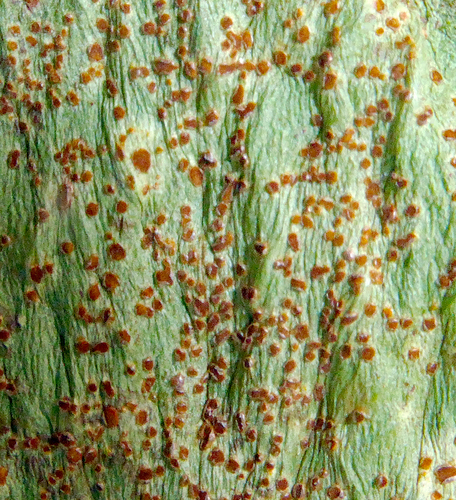
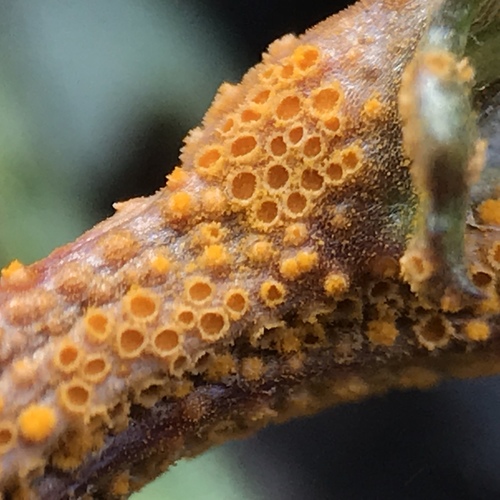
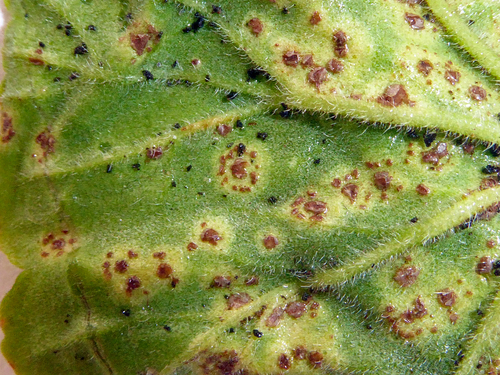
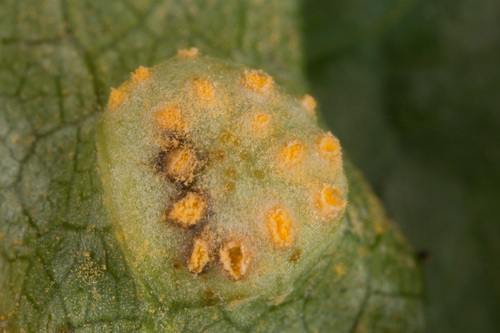
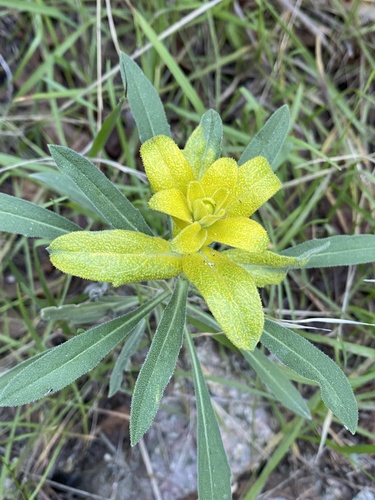
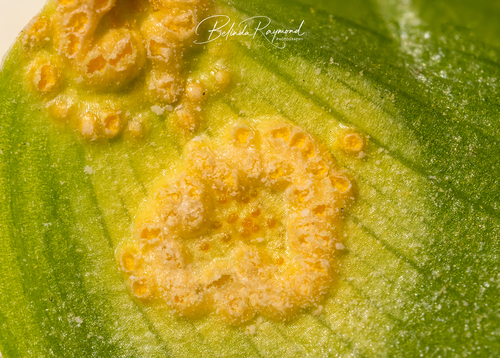
This rust fungus first appears from early to late autumn, forming small, orange, wart-like structures called spermagonia (also called pycnia) on the upper surface of leaves of Asparagus asparagoides. This is the first stage of its disease cycle. Next, orange cup-shaped aecia form on the underside of leaves. Aecia produce aeciospores, which lead to the development of uredinia. Both uredinia and telia form on the underside of leaves, and also occur on stems. Uredinia are orange, pustule-shaped structures that produce urediniospores, which are dispersed by wind. Several weeks after uredinia form, brown-black, pustule-shaped telia develop, and produce thick-walled resting spores called teliospores.
P. myrsiphylli is likely macrocyclic, because it produces all five spore stages. It is also likely autoecious: field observations have recorded pycnia, aecia, uredinia, and telia all on A. asparagoides, and the fungus does not require any other host plant species to complete its life cycle. Researchers conducting this study found dormant teliospores on heavily diseased cladodes and stems during spring to early summer in South Africa's winter rainfall region. This indicates that the fungus survives dry summer months on host debris, when the above-ground growth of its host plant stops. The thick-walled teliospores allow the rust to survive as its host bridal creeper (A. asparagoides) deteriorates over summer. P. myrsiphylli completes a new infection cycle every 3–4 weeks during the growing season.
Puccinia myrsiphylli has two known natural enemies: larvae of Cecidomyiidae and the fungus Eudarluca caricis. These two enemies do not appear to have a major impact on P. myrsiphylli populations.
In terms of distribution and habitat, Puccinia myrsiphylli occurs in Eastern Cape Province, South Africa. Within South Africa, it is found in winter rainfall regions, aseasonal regions, and summer rainfall regions, occurring across all areas where A. asparagoides is widespread. In southern Africa, the presence of P. myrsiphylli depends on the presence of living host foliage and seasonal rainfall patterns. The species is a highly flexible pathogen, demonstrated by its wide distribution across many different climate regions of South Africa, and its ability to survive harsh, dry conditions without a living host. Puccinia myrsiphylli can also be found in Australia and New Zealand.