About Puccinia mariae-wilsoniae Clinton
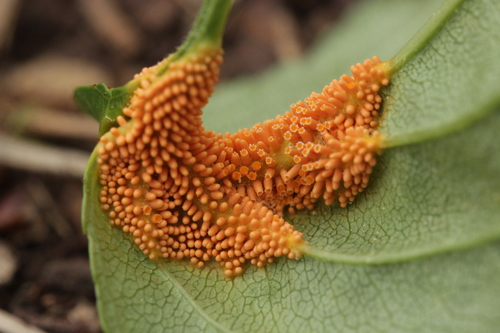
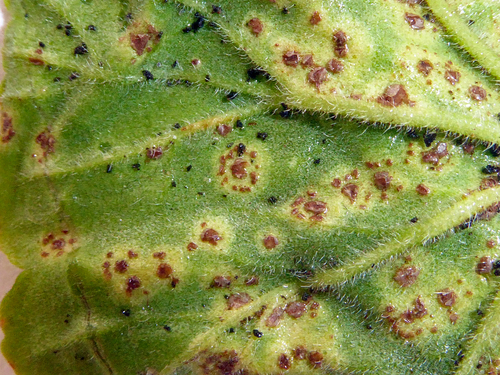
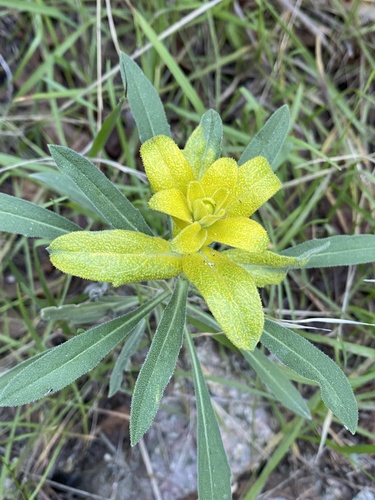
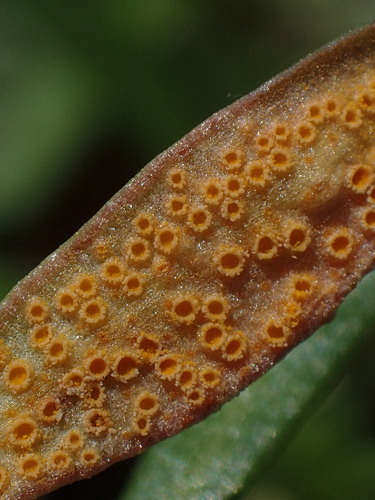
Puccinia mariae-wilsoniae Clinton is a species of rust fungus. This rust grows on all sides of its host plants, forming scattered clusters of reddish-brown sori on the plant surface. Its specialized reproductive structures called aecia are cup-shaped and have a noticeable peridium. The aeciospores (spores produced by aecia) are translucent, covered with tiny warts, and measure 18–27 μm by 14–20 μm. Its telia measure around 0.1–1.0 mm in diameter and are dark brown; the teliospores of the main variety are 33–56 μm by 16.5–27 μm, with brownish walls 1.5–2.5 μm thick. These teliospores are two-celled, with little to no constriction at the septum, and their surface is ornamented with rounded warts 0.2–0.5 μm high, with 1.4–3.0 μm between the centers of adjacent warts. The variety Puccinia mariae-wilsoniae var. montiae differs from the primary form in the dimensions of its teliospores, which measure 27–46 by 20–28.5 μm, have walls 1.6–3.0 μm thick, and have warts 0.9–1.7 μm high. This rust fungus grows on the leaves and stems of plants belonging to the Portulacaceae family. Known host species for the main variety include Claytonia caroliniana (Carolina spring beauty), C. virginica (Virginia spring beauty, or fairy spud), Claytonia lanceolata (lanceleaf springbeauty), Montia fontana, and Montia sibirica. Puccinia mariae-wilsoniae is only found in North America, where it is common across the United States and Canada. The variety montiae has only been collected in Washington, California, and Utah, and its host species are Montia sibirica and Montia cordifolia.