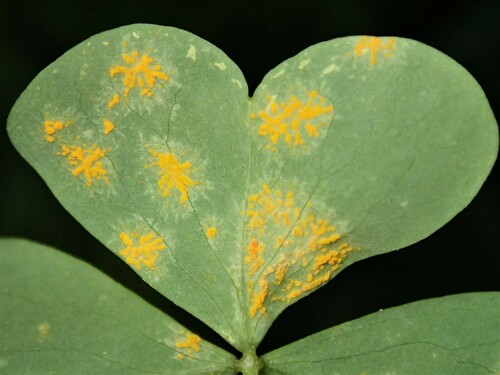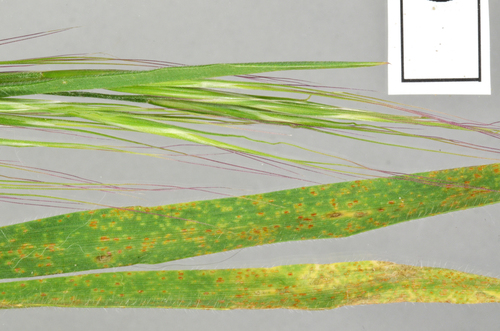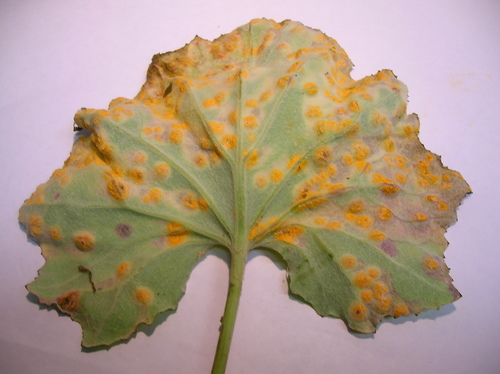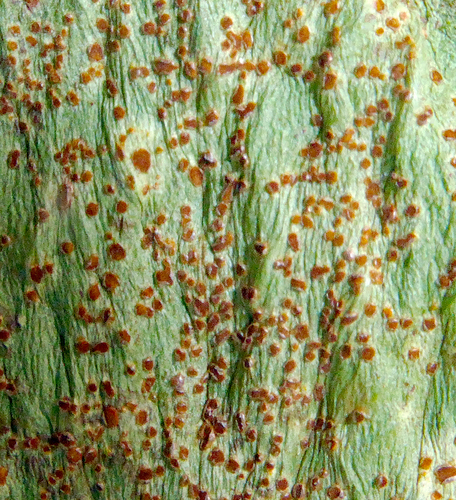
About Puccinia graminis Pers.
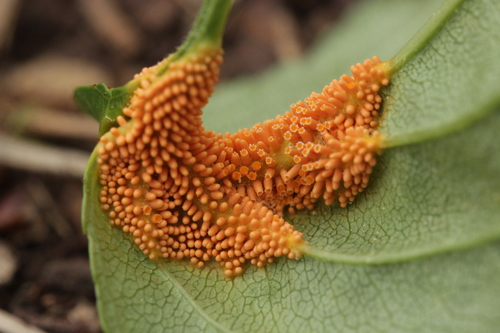
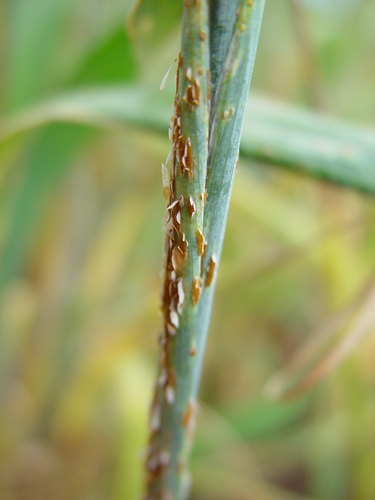
Stem rust, also called cereal rust, black rust, red rust, or red dust, is a significant disease of cereal crops caused by the fungus Puccinia graminis Pers. Crop species affected by the disease include bread wheat, durum wheat, barley, and triticale. Stem rust has impacted cereal farming throughout human history. K. C. Mehta discovered that wheat stem rust recurs annually on the North Indian plains. Since the 1950s, wheat strains bred for resistance to stem rust have been available, and effective fungicides against the disease are also available. In 1999, a new, more virulent race of stem rust that most current wheat strains have no resistance against was identified, named TTKSK (with isolate Ug99 as an example). An epidemic of wheat stem rust caused by race TTKSK spread across Africa, Asia, and the Middle East, raising major concern because large numbers of people depend on wheat for food, so the epidemic threatens global food security. In 2016, an outbreak of another virulent stem rust race, TTTTF, occurred in Sicily, indicating that the disease is returning to Europe. Comprehensive genomic analysis of Puccinia graminis, combined with plant pathology and climate data, has identified the potential for re-emergence of wheat stem rust in the United Kingdom. Like other species in the Puccinia genus, P. graminis is an obligate biotroph, meaning it colonizes living plant cells, and has a complex life cycle with alternation of generations. The fungus is heteroecious, meaning it requires two different hosts to complete its life cycle: a cereal host and an alternate host. Many species in the genera Berberis, Mahonia, and their hybrid genus ×Mahoberberis are susceptible to stem rust, but the common barberry (Berberis vulgaris) is considered the most important alternate host. P. graminis is macrocyclic, meaning it produces all five spore types known for rust fungi. It can complete its life cycle either with or without barberry, its alternate host. The obligately biotrophic lifestyle of P. graminis f.sp. tritici involves strong up-regulation of specific gene transcriptions, which forms its biotrophy genomic features. These genomic regions have parallels in other eukaryotic plant pathogens. The parallels between these independently evolved, unrelated sets of genes show a strong, broad pattern of convergent evolution around the plant pathogenic lifestyle. Because the life cycle of P. graminis is cyclical, it has no true 'start point'. For this description, the production of urediniospores is arbitrarily chosen as the starting point. Urediniospores form in structures called uredinia, which are produced by fungal mycelia on the cereal host 1–2 weeks after infection. The urediniospores are dikaryotic, meaning each cell contains two unfused haploid nuclei, and form on individual stalks inside the uredinium. They are spiny and brick-red. Urediniospores are the only spore type in the rust fungus life cycle that can infect the host they are produced on, so this stage is called the 'repeating stage' of the life cycle. The spread of urediniospores allows infection to move from one cereal plant to another, and this phase can rapidly spread infection across a wide area. Near the end of the cereal host's growing season, mycelia produce structures called telia. Telia produce a type of spore called teliospores. These black, thick-walled spores are dikaryotic, and they are the only form of Puccinia graminis that can overwinter independently of a host. Each teliospore undergoes karyogamy, the fusion of nuclei, and meiosis to form four haploid spores called basidiospores. This process is an important source of genetic recombination in the life cycle. Basidiospores are thin-walled and colourless. They cannot infect the cereal host, but can infect the alternate host (barberry), and they are usually carried to the alternate host by wind. Once basidiospores reach a leaf of the alternate host, they germinate to produce haploid mycelium that directly penetrates the leaf epidermis and colonizes the leaf. Once inside the leaf, the mycelium produces specialized infection structures called pycnia. Pycnia produce two types of haploid gametes: pycniospores and receptive hyphae. Pycniospores are produced in a sticky honeydew that attracts insects, which carry pycniospores from one leaf to another. Splashing raindrops can also spread pycniospores. A pycniospore can fertilize a receptive hypha of the opposite mating type, leading to the growth of dikaryotic mycelium. This is the sexual stage of the life cycle, and cross-fertilization provides another important source of genetic recombination. This dikaryotic mycelium then forms structures called aecia, which produce a type of dikaryotic spores called aeciospores. Aeciospores have a warty surface and form in chains, unlike the spiny urediniospores that grow on individual stalks. The chains of aeciospores are surrounded by a bell-like enclosure of fungal cells. Aeciospores can germinate on the cereal host but not on the alternate host (they are produced on the alternate host, usually barberry). They are carried by wind to the cereal host, where they germinate and their germ tubes penetrate into the plant. The fungus grows inside the plant as dikaryotic mycelium, and within 1–2 weeks the mycelium produces uredinia, completing the cycle. Because urediniospores are produced on the cereal host and can infect the cereal host, P. graminis can pass infection from one year's crop to the next without infecting the alternate host (barberry). For example, infected volunteer wheat plants can act as a bridge between growing seasons. In other cases, the fungus moves between winter wheat and spring wheat, meaning it has a cereal host available year-round. Since urediniospores are dispersed by wind, this cycle can occur over large distances. This cycle consists purely of vegetative propagation: urediniospores infect one wheat plant, leading to the production of more urediniospores that then infect other wheat plants.