About Ptychosperma elegans (R.Br.) Blume
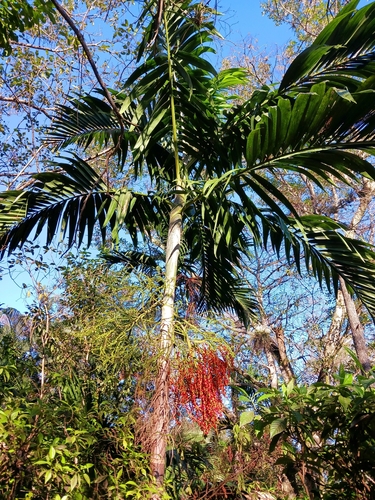
Ptychosperma elegans (R.Br.) Blume is a solitary-stemmed palm that grows to a height of 10–12 m (33–39 ft). Its slender stem reaches 8–10 cm (3.1–3.9 in) in diameter, is slightly bulging at the base, light grey in colour, and marked with prominent leaf scars that encircle the trunk. The crown usually holds 7 to 11 pinnate fronds, which reach around 3 metres (9.8 ft) in length. The petiole, or leaf stem, is about 30 cm (12 in) long; the crownshaft is around 60 cm (24 in) long, mid-green in colour, and covered in a whitish waxy coating. There are between 30 and 60 pinnae, or leaflets, on each side of the rachis (midrib). Leaflets reach up to 84 cm (33 in) long at the middle of the frond and are shorter toward both ends, with an obliquely praemorse tip, meaning it has a jagged edge like a fishtail.
Inflorescences are about 70 cm (28 in) long and grow from the trunk just below the crownshaft. Flowers occur in groups of three: each group contains one functionally female pistillate flower and two functionally male staminate flowers. All flowers are light green with 3 sepals and 3 petals. Staminate flowers are about 6 mm (0.24 in) long, with 12–22 stamens. Pistillate flowers measure about 5 mm (0.20 in), with 6 staminodes and a 1 mm (0.039 in) recurved stigma.
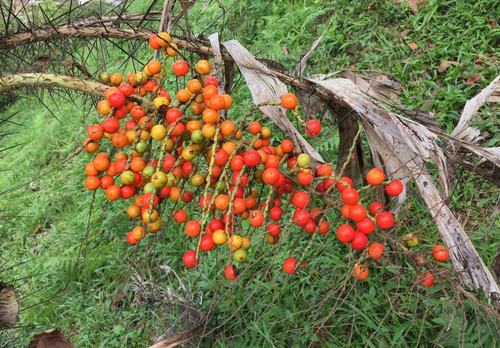
Fruits of Ptychosperma elegans measure 9–15 mm (0.35–0.59 in) long and 8–10 mm (0.31–0.39 in) wide, and turn bright red when ripe, with the remains of the stigma attached at one end. A thin layer of flesh surrounds the solitary seed, which is about 10 mm (0.39 in) long and 7 mm (0.28 in) wide, with five deep longitudinal grooves.
This species is endemic to Queensland, Australia, where it grows as an understory tree in both tropical and subtropical rainforests. It often grows close to rivers and streams, where water is plentiful and drainage is good, and occurs at altitudes ranging from sea level to 900 m (3,000 ft).
This tropical species is a popular ornamental palm grown in gardens and parks, valued for its appealing arched crown, slender trunk, and red fruit. It grows less successfully in cooler climates and is somewhat susceptible to frosts. Potted or indoor specimens require high amounts of light, as well as humid and warm conditions. A blight that causes dark brown patches to cover leaves, especially in subtropical climates, does not appear to interfere with the plant's growth. In cultivation, this single-trunked tree can reach 6.1–12.2 m (20–40 feet) in height. It has been naturalized in South Florida since at least the 1950s, and is still the only member of its genus that is naturalized in the United States of America. Due to its intolerance to cold, it is mostly found in South Florida and coastal Tampa. It is also cultivated in coastal Southern California, primarily in Orange and San Diego counties.