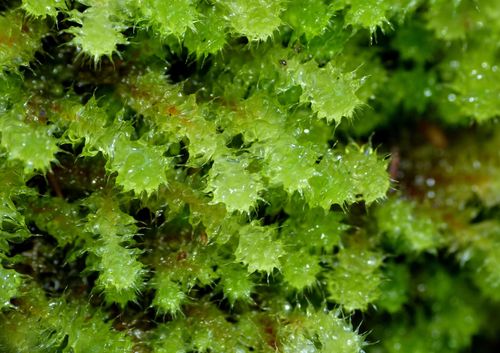
About Ptychomnion aciculare (Brid.) Mitt.
The scientific name of this moss is Ptychomnion aciculare (Brid.) Mitt. Its genus name comes from Greek, with ptychios meaning 'folded' and mnion meaning 'moss'.
Habitat and Distribution
This species is possibly the most common moss found in wet forests and rainforests across the southern hemisphere. It grows at ground level, especially on humus soils, on fallen trees and logs, and sometimes grows as an epiphyte.
Growth Form
It often forms large, extensive mats. It is easy to identify thanks to its prostrate red stems, which bear irregular squarrose, rugose leaves that measure 2 to 3.5mm in length.
Desiccation Appearance
When desiccated, it resembles a pipe-cleaner tool. It is typically bright green when wet, and turns yellow-brown as it dries out.
Stem Structure
This moss is generally robust. Its stems stand erect at varying heights, and the brown stem is visible for most of its length, up to the leaf apex.
Leaf Morphology
Leaves become greener and more closely spaced toward stem tips, and have an irregular but cochleate shape. Leaves are wider at the base before tapering, and reach a maximum length of 5mm.
Reproductive Type
Ptychomnion aciculare is dioecious, and an upright sporangium is often visible. Female stems produce perichaetia, the protective tissues that surround the developing seta and sex organs.
Sporophyte Structure
The seta is usually brown, 20-30mm long, and bears a reddish-brown capsule. The operculum is similar in size to the capsule, with a teethed exostome and ciliated endostome.
Spore and Vegetative Features
Spores are 10-15 μm in size. Unlike many other bryophytes, this species does not produce gemmae or paraphyllia. It has a very wide distribution, particularly across Australia and New Zealand.
Male Individual Characteristics
This moss is unisexual. Male individuals occur as full-size, dwarfed, or leaf-attached forms, and males can usually only be observed with a hand lens.
Sporophyte Identification
Reproductive individuals are easily recognized by the presence of a sporophyte, which is marked by an erect brown seta with an attached capsule. The seta only turns brown once it reaches full maturity, when it no longer needs to perform photosynthesis to support growth.
Sporophyte Development
The developing sporophyte is covered by a calyptra, a protective cap. As the sporophyte dries, the operculum eventually opens.
Spore Dispersal Mechanism
The peristome, the final structure enclosing the spores, absorbs water during rain and opens to create a cavity that releases spores. This allows the tiny spores (measuring 10 to 12 μm) to be dispersed by wind and rain.
Known Uses
There are no known uses for Ptychomnion aciculare apart from use in floral decorations. Note that other moss species have a range of other uses, including as fertilizer, biofuel, for medicinal purposes, and in various production processes.


