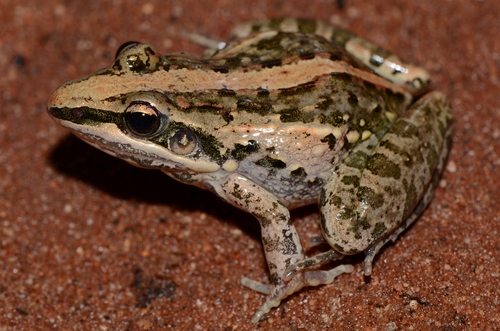
About Ptychadena mossambica (Peters, 1854)
Adult Size
Ptychadena mossambica (Peters, 1854) adults measure 45–50 mm in length, with a maximum recorded length of 53 mm. Internarial distance is greater than the distance from the snout tip to the nostril.
Dorsal Coloration
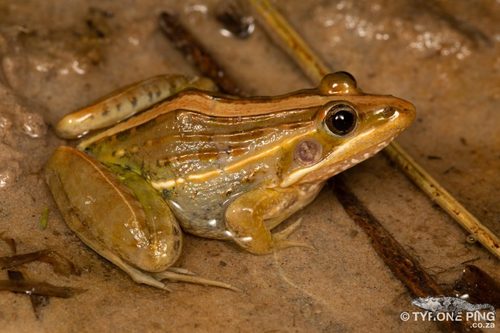
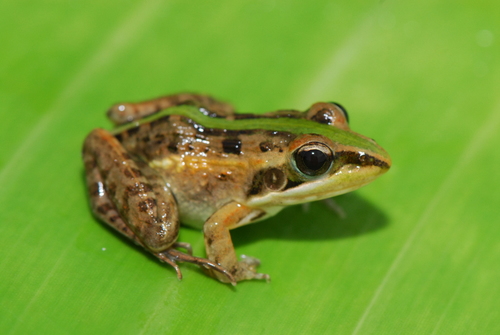
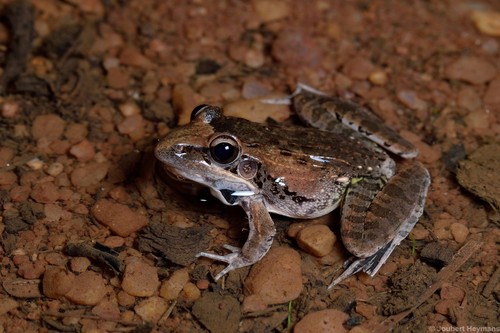
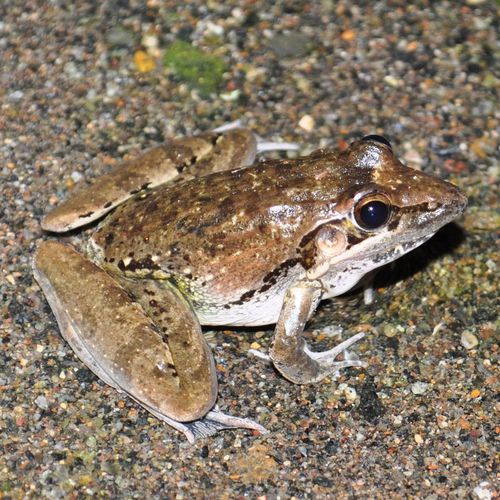
The dorsal surface of the body ranges from dark grey-brown to chocolate brown or green. A broad creamy to orange-brown vertebral stripe extends from the snout to the vent, bordered by elongated blackish spots.
Snout Characteristics
The snout does not have a prominent pale triangle, and is not paler than the rest of the body.
Dorsolateral Ridges
There are 6 or more prominent creamy-white dorsolateral skin ridges, which are only continuous as far as the back hump. Between the vertebral band and the dorsolateral ridges are dark brown blotches smaller than the eye.
Tympanum Features
The tympanum is prominent and slightly smaller than the eye.
Underside Coloration
The underside is creamy-white, sometimes with grey mottling along the lower jaw on the throat and on the hind part of the abdomen. The thighs and groin are often pale yellow, and the skin is smooth.
Forelimb Length
The forelimb is comparatively short.
Hindlimb Proportions
For the hindlimb, the foot is shorter than the tibia. A pale line is sometimes present along the upper surface of the tibia.
Thigh Rear Pattern
The back of the thigh is dark grey, with yellow mottling that sometimes forms irregular lines.
Foot Webbing
Webbing is moderate: 2.75 to 3 phalanges of the fourth toe and one phalanx of the fifth toe are free of webbing.
Foot Tubercles
A tarsal fold is present, both inner and outer metatarsal tubercles are present, and there is a row of tubercles under the fourth toe.
Sexual Dimorphism
For sexual dimorphism, male gular slits are not parallel to the jaw line when viewed laterally.
Identification Overview
Key identification features separate this species from close relatives.
Distinction From P. subpunctata, P. taenioscelis and P. guibei
Yellow mottling on the back of the thighs that sometimes forms irregular lines distinguishes it from P. subpunctata, P. taenioscelis and P. guibei.
Distinction By Internarial Distance
Internarial distance greater than snout-nostril distance distinguishes it from most other species except P. guibei, P. mapacha and P. schillukorum.
Distinction By Foot Length
Foot length shorter than tibia length distinguishes it from P. guibei, P. mascareniensis, P. subpunctata and P. taenioscelis.
Distinction By Tibial Line
A sometimes present pale line on the tibia distinguishes it from P. anchietae, P. oxyrhychus, P. schillukorum and P. taenioscelis, though this line may also sometimes occur in P. subpunctata.
Distinction By Metatarsal Tubercle
Presence of an outer metatarsal tubercle distinguishes it from most other species except P. guibei, P. mapacha and P. schillukorum.
Distinction By Vertebral Band
A broad pale band extending from the snout to the rump, with the snout not paler than the rest of the body, distinguishes it from P. anchietae, P. oxyrhynchus, P. schillukorum and P. subpunctata. Mottling on the back of the thighs is irregular with no discernible pattern.
Species Distribution
This species is found in South Africa from northern Zululand through the Lowveld and Kruger National Park, northwards into Botswana, Eswatini, Kenya, Malawi, Mozambique, Namibia, Tanzania, Zambia, Zimbabwe, and may also occur in Angola.
Observation Locations
Recommended locations to observe the species are Kruger-Lowveld in South Africa, Okavango in Botswana, and Tshaneni in Eswatini.
General Habitat
Its natural habitats are flooded grass and rush around intermittent pans and permanent freshwater marshes (vleis), ponds, or streams across a variety of bushveld vegetation types, at altitudes between 200 and 1200 m.
Additional Habitats
Habitats include dry savanna, thicket, subtropical or tropical dry and seasonally wet or flooded lowland grassland, as well as moist savanna, subtropical or tropical dry forest, subtropical or tropical dry and moist shrubland, swamps, intermittent freshwater lakes, arable land, pastureland, and water storage areas.
Egg Count
For reproduction, 315 eggs were collected from a single female in Kruger National Park.
Egg Morphology
Each egg is 1.2 mm in diameter, surrounded by a transparent jelly layer around 3 mm in diameter. Eggs sink to the bottom.
Egg Coloration
The animal pole of the egg is dark grey-brown, while the vegetal pole is creamy yellow-white.
Egg Development
Eggs develop very quickly.