About Ptyas mucosa (Linnaeus, 1758)
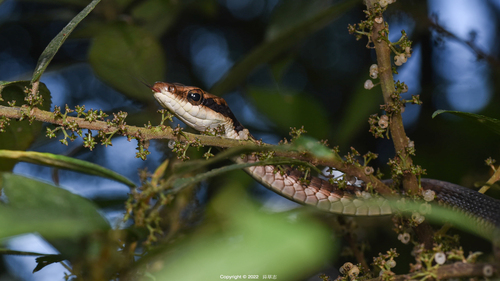
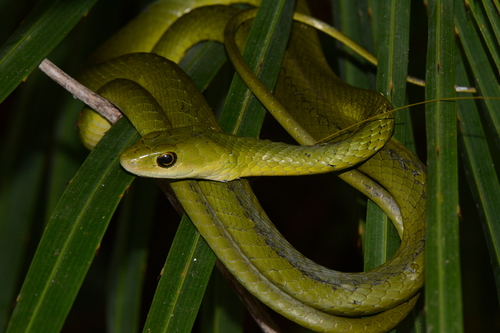
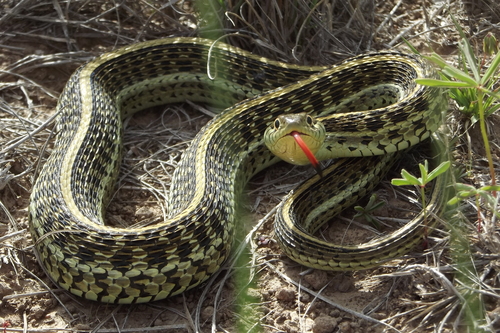
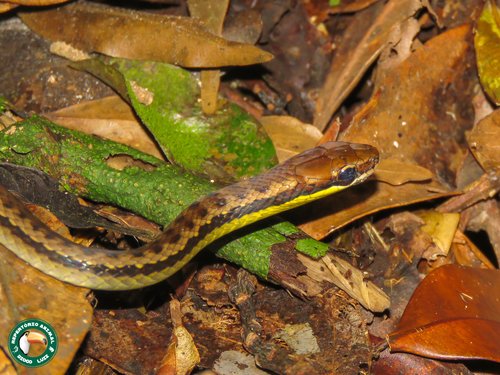
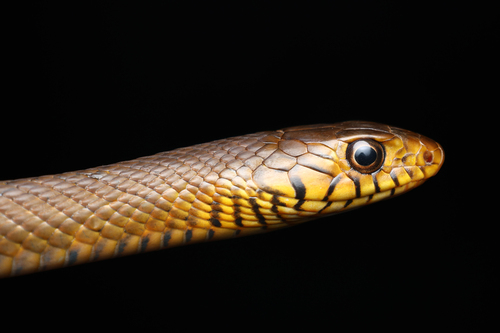
This description of Ptyas mucosa (Linnaeus, 1758) is reproduced from Boulenger's 1890 volume Fauna of British India: Reptilia and Batrachia. The snake has an obtuse, slightly projecting snout, and a large eye. Its rostral scale is a little broader than deep, and is visible from above. The suture between the internasals is shorter than the suture between the prefrontals. The frontal scale is as long as its distance from the end of the snout, and as long as the parietal scales or slightly shorter. There are usually three loreal scales, one large preocular scale with a small subocular below it, and two postocular scales. Temporal scales follow a 2+2 arrangement. There are 8 upper labials, with the fourth and fifth entering the eye. 5 lower labials contact the anterior chin shields, which are shorter than the posterior chin shields; the posterior chin shields are in contact with each other anteriorly. Dorsal scales are arranged in 17 rows at midbody, and are more or less strongly keeled on the posterior part of the body. Ventral scales number 190–208, the anal scale is divided, and subcaudal scales, which number 95–135, are divided. The upper body is brown, and often has more or less distinct black crossbands on the posterior part of the body and the tail; young individuals usually have light crossbands on the front half of the body. The lower surface is yellowish, and the posterior ventral and caudal scales may be edged with black. This species is the second largest snake found in Sri Lanka, after the Indian rock python. This species is distributed across Afghanistan, Bangladesh, Myanmar, Cambodia, China (including Zhejiang, Hubei, Jiangxi, Fujian, Guangdong, Hainan, Guangxi, Yunnan, Tibet, and Hong Kong), Taiwan, India (including the Andaman and Nicobar Islands), Sri Lanka, Indonesia (including Sumatra, Java, and Bali), Iran, Laos, West Malaysia, Nepal, Pakistan (the Sindh area), Thailand, Turkmenistan, and Vietnam. As a species of rat snake, Ptyas mucosa is harmless to humans, but is fast-moving and excitable. They are diurnal and semi-arboreal. They inhabit forest floors, wetlands, rice paddies, farmland, and suburban areas, where they prey on small reptiles, amphibians, birds, and mammals. Unusually for a colubrid, adult individuals prefer to subdue their prey by sitting on it rather than by constricting, using their body weight to weaken the prey. In captivity, they are territorial and may defend their space aggressively, attempting to startle or strike at passing objects. Rat snakes mate in late spring and early summer, though reproduction may occur year round in tropical areas. Males establish territory boundaries through a ritualized strength test, in which they intertwine their bodies. This behavior is sometimes misinterpreted by observers as a "mating dance" between individuals of the opposite sex. Several weeks after mating, females produce a clutch of 6 to 15 eggs.