About Ptilotus polystachyus (Gaudich.) F.Muell.
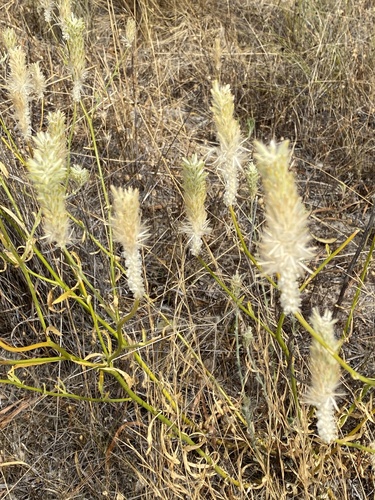
Ptilotus polystachyus (Gaudich.) F.Muell. is an annual or short-lived perennial plant that usually reaches a height of 0.15 to 1 m (5.9 in – 3 ft 3.4 in), and has ribbed stems. Its stems and leaves have a small number of branched hairs, and often become hairless (glabrous) as the plant ages. Stem leaves are arranged alternately, with shapes ranging from linear to oblong, or from narrowly elliptic to lance-shaped. They measure 45–200 mm (1.8–7.9 in) long and 7–35 mm (0.28–1.38 in) wide, grow on a short petiole, and have wavy edges. No leaves grow at the base of this plant. Its flowers are pale green, greenish yellow to straw-coloured, or dull purplish brown. Flowers are arranged in a cylindrical spike 30–120 mm (1.2–4.7 in) long and approximately 30 mm (1.2 in) in diameter. At the base of each flower, there are egg-shaped bracts 3–4.5 mm (0.12–0.18 in) long, and circular to broadly elliptic bracteoles of roughly the same length. The perianth is 13–16 mm (0.51–0.63 in) long; the outer surface of the tepals is fairly densely covered with long, silky hairs, while the inner surface is glabrous. This species has three or four stamens, and a sessile ovary with an eccentric style. Flowering can occur in most months of the year, but peaks between May and November.
This species is endemic to Australia, and occurs in all mainland Australian states and the Northern Territory. In Western Australia, it grows in red soils, sand, and on sandstone on stony hills and plateaus. In the Northern Territory, it mostly grows on sandplains, dunefields, and intermittent watercourses. It occupies a wide variety of habitats in South Australia. It is common in drier areas of New South Wales. In Victoria, it is rare, restricted to the far north-west of the state, where it grows on low dunes and in the heavier soils of the Murray River floodplain. In Queensland, this species is listed as of "least concern".