About Ptilotus nobilis (Lindl.) F.Muell.
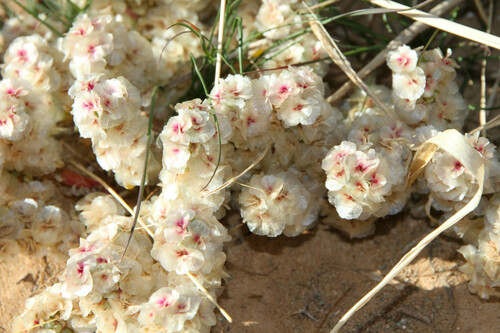
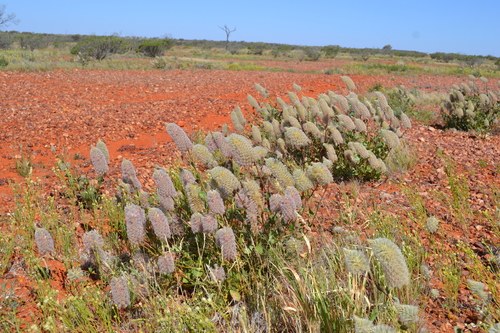
Ptilotus nobilis is an erect annual or short-lived perennial herb that produces several stems. It typically reaches a height of 30 to 60 cm (12 to 24 in), and can occasionally grow as tall as 1 m (3 ft 3 in). Leaves are egg-shaped to lance-shaped, with the narrower end positioned toward the base. Basal leaves are 50–140 mm (2.0–5.5 in) long and 10–35 mm (0.39–1.38 in) wide, thick and hairless. Stem leaves have a similar shape but are smaller than basal leaves. Flowers are arranged in erect, cylindrical spikes that measure 50–120 mm (2.0–4.7 in) long and 40–50 mm (1.6–2.0 in) in diameter. Each flower has egg-shaped bracts around 10 mm (0.39 in) long at its base, plus similar smaller bracteoles. The perianth is 20–25 mm (0.79–0.98 in) long; the tepals are free from each other except for a united base, and the outer half of the tepals is covered in silky hairs. There are three or four stamens, and the ovary is held on a stalk, with a slightly S-shaped style at its center. Flowering takes place from August to December. This species of Ptilotus grows in open shrublands, grasslands, open stony plains, gravelly ranges, hills, and rises, in fine-textured, loamy, clayey, rocky, or sandy soils. It occurs across Western Australia, South Australia, the Northern Territory, Queensland, the slopes and western plains of New South Wales, and Victoria.