About Ptilotus manglesii (Lindl.) F.Muell.
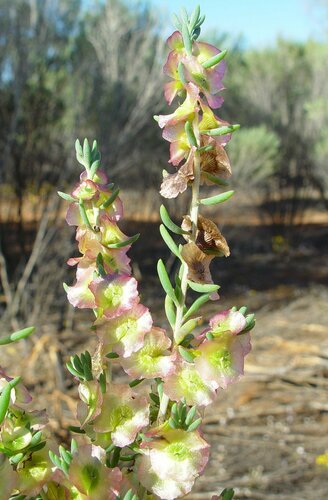
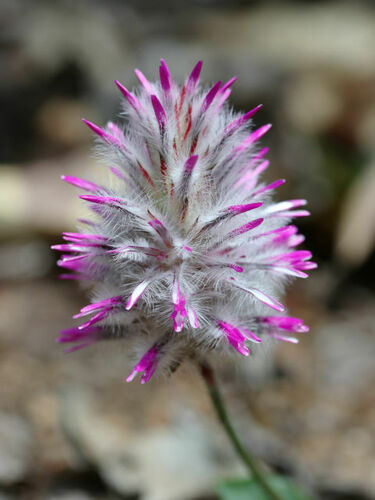
Ptilotus manglesii (Lindl.) F.Muell. is a perennial herb that grows 100–400 mm (3.9–15.7 in) tall and 150–400 mm (5.9–15.7 in) wide. It has terete stems that are typically low-lying or prostrate, and rarely erect, reaching 70–300 mm (2.8–11.8 in) in length. Basal leaves are spatula-shaped to lance-shaped, with the narrower end toward the base, measuring 40–150 mm (1.6–5.9 in) long and 10–60 mm (0.39–2.36 in) wide. Stem leaves are lance-shaped to egg-shaped, 15–70 mm (0.59–2.76 in) long and 5–14 mm (0.20–0.55 in) wide. Its flowers are pink or magenta, arranged in oval or cylindrical spikes that are 25–70 mm (0.98–2.76 in) long and 38–50 mm (1.5–2.0 in) wide. It has egg-shaped to lance-shaped bracts 10–13.5 mm (0.39–0.53 in) long, and similar-sized bracteoles 13–15 mm (0.51–0.59 in) long. Outer sepals are lance-shaped and 17–28 mm (0.67–1.10 in) long, while inner sepals are also lance-shaped, more or less downcurved, and 15–25 mm (0.59–0.98 in) long. This species has three to five stamens and up to two staminodes. The style is curved, 4.0–6.5 mm (0.16–0.26 in) long, and attached to the side of the ovary. Seeds are dull brown, about 3.1 mm (0.12 in) long and 1.7 mm (0.067 in) wide. Flowering takes place from September to December or January. Commonly called pom poms, this plant usually grows on sandy and gravelly soils. It is found in the Avon Wheatbelt, Esperance Plains, Geraldton Sandplains, Jarrah Forest, Mallee, Swan Coastal Plain and Warren bioregions of south-western Western Australia.