About Ptilotus macrocephalus (R.Br.) F.Muell.
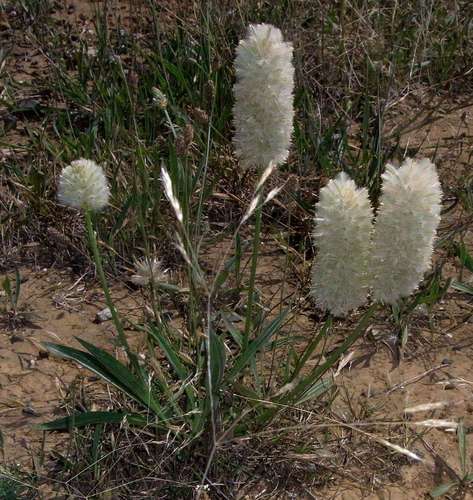
Ptilotus macrocephalus (R.Br.) F.Muell., commonly called green pussytails, is a glabrous or slightly hairy perennial herb with a woody taproot, typically growing up to about 50 cm (20 in) tall. Its leaves are linear to narrowly lance-shaped or narrowly egg-shaped, about 30–100 mm (1.2–3.9 in) long and 4–12 mm (0.16–0.47 in) wide. The leaves are somewhat thick, and are crowded near the base of the plant or form a rosette. The species produces yellowish green or silvery white flowers, densely arranged in oblong to cylindrical spikes. It has straw-coloured, translucent, egg-shaped to lance-shaped bracts that are 11–20 mm (0.43–0.79 in) long, and elliptic bracteoles that are shorter than the bracts. The perianth segments are 25–30 mm (0.98–1.18 in) long; their outer surface is covered in long hairs except for the glabrous tip, while the inner surface is fully glabrous. This species has three or four stamens plus one staminode. The style is 17–22 mm (0.67–0.87 in) long, hairy on one side, and attached to the side of the ovary. Flowering occurs mainly from October to February. Green pussytails grows in grassland, grassy woodland, and heath. While it was once thought to occur across most of the Australian mainland, current research restricts the distribution of P. macrocephalus to south-eastern Australia, mostly in south-eastern South Australia, Victoria, and New South Wales. A 2019 study by Hammer et al. determined that specimens previously identified as P. macrocephalus actually belong to two morphologically and ecologically distinct species that have since been formally named: Ptilotus xerophilus T.Hammer & R.W.Davis, found in arid central and western Australia, and Ptilotus psilorhachis T.Hammer & R.W.Davis, found in eastern Queensland. Ptilotus macrocephalus has cream-green oval flower heads. Like other green-flowered Ptilotus species such as Ptilotus nobilis, it is thought to be pollinated predominantly by nocturnal moths.