About Ptilotus clementii (Farmar) Benl
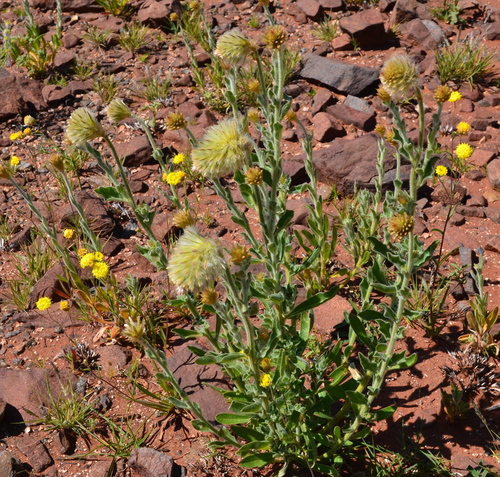
Ptilotus clementii is an erect, compact shrub that usually grows between 0.3 and 1 metre (1 foot 0 inches to 3 feet 3 inches) tall. It has hairy stems and leaves. The leaves are lance-shaped to elliptic, between 15 and 60 millimetres (0.59 to 2.36 inches) long, and 4 to 13 millimetres (0.16 to 0.51 inches) wide. This species produces green flowers, held in oval to cylindrical heads that are 30 to 80 millimetres (1.2 to 3.1 inches) long and 35 to 53 millimetres (1.4 to 2.1 inches) wide. At the base of each flower are bracts 7.5 to 10.5 millimetres (0.30 to 0.41 inches) long with a prominent midrib, and similar bracteoles 6.6 to 10 millimetres (0.26 to 0.39 inches) long. The outer tepals are 18 to 23 millimetres (0.71 to 0.91 inches) long, while the inner tepals are 17 to 22 millimetres (0.67 to 0.87 inches) long and glabrous on their inner surface. There are five stamens, and the style is sometimes S-shaped, measuring 11.6 to 18 millimetres (0.46 to 0.71 inches) long. Flowering takes place from March to November, and the resulting fruit is 2 to 4 millimetres (0.079 to 0.157 inches) long and 1 to 2 millimetres (0.039 to 0.079 inches) wide. Commonly called tassel top, this plant grows on rocky hills, limestone ridges and plains. In Western Australia, it occurs in the Carnarvon, Central Ranges, Dampierland, Gascoyne, Gibson Desert, Great Sandy Desert, Great Victoria Desert, Little Sandy Desert, Ord Victoria Plain, Pilbara and Tanami bioregions. In the Northern Territory, it is found in the Burt Plain, Central Ranges, Channel Country, Davenport Murchison Ranges, Finke, Gibson Desert, Great Sandy Desert, Gulf Fall and Uplands, Gulf Plains, Little Sandy Desert, MacDonnell Ranges, Mitchell Grass Downs, Mount Isa Inlier, Ord Victoria Plain, Pilbara, Simpson Strzelecki Dunefields and Tanami bioregions. It also grows in the Mount Isa-Cloncurry area of north-west Queensland.