About Pterostylis tunstallii D.L.Jones & M.A.Clem.
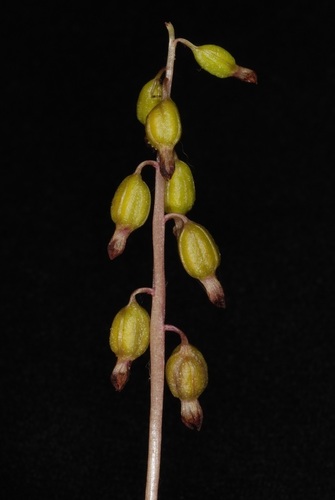
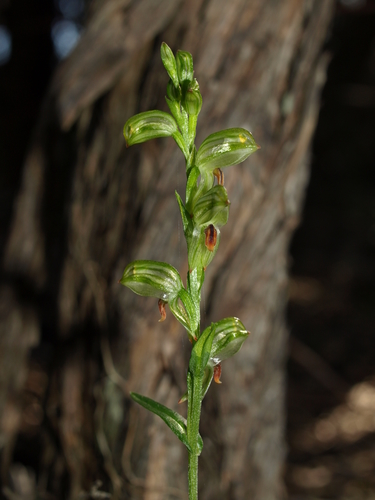
Pterostylis tunstallii D.L.Jones & M.A.Clem. is a terrestrial, perennial, deciduous herb that grows from an underground tuber. Non-flowering individuals produce a rosette of three to five egg-shaped leaves on a stalk 30–60 mm long. Each leaf measures 10–40 mm in length and 4–9 mm in width. Flowering plants bear up to ten transparent green flowers on a flowering spike that reaches 150–500 mm high. This flowering spike has between five and eight stem leaves, which are 30–60 mm long and 3–5 mm wide. Individual flowers are 7–10 mm long and 5–7 mm wide. The dorsal sepal and petals are fused to form a hood, or "galea", that covers the column, and the dorsal sepal has a short point at its tip. The lateral sepals turn downwards, and measure 7–10 mm long and 5–7 mm wide. They are joined for most of their length, and have a narrow tip about 4 mm long that is brown at its end. The labellum is insect-like, about 5 mm long and 2 mm wide, and is dark brown with a blackish "head" at its end. Flowering takes place from July to August. Tunstall's greenhood occurs from the Blue Mountains in New South Wales southwards, in southern Victoria east of Wilsons Promontory, and in Tasmania including the Bass Strait islands. It grows in moist forest in coastal and near-coastal districts.