About Pterostylis trullifolia Hook.f.
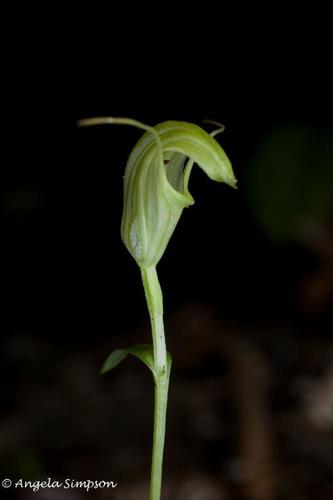
Pterostylis trullifolia Hook.f. is a terrestrial, perennial, deciduous herb that grows from an underground tuber. When it is not flowering, it produces a rosette of leaves. These leaves are dark green to reddish-green, wrinkled, and trowel-shaped, measuring 5–10 mm (0.2–0.4 in) in both length and width, and each is attached to a petiole up to 10 mm (0.4 in) long. When flowering, plants produce a single green flower with white stripes, borne on a flowering stem that can reach up to 300 mm (10 in) in height. This stem carries between two and eight spreading stem leaves, which are 5–20 mm (0.2–0.8 in) long and 2–5 mm (0.08–0.2 in) wide. The dorsal sepal and petals are fused together to form a hood, called a 'galea', that covers the column. The dorsal sepal curves forward and ends in a short pointed tip. The lateral sepals are held close against the galea, and have erect, thread-like tips that are much taller than the galea. A bulging U-shaped gap (sinus) sits between the bases of the two lateral sepals. The labellum is dark brown to reddish-brown and protrudes above the sinus. Flowering takes place from May to September. This species, commonly called the trowel-leaved greenhood, grows from coastal to montane forests at altitudes up to 1,100 m (4,000 ft). It sometimes grows in rough pasture and lawns located near forests. It is widespread across the North Island, Three Kings Islands, and the northern part of the South Island, north of Canterbury.