About Pterostylis squamata R.Br.
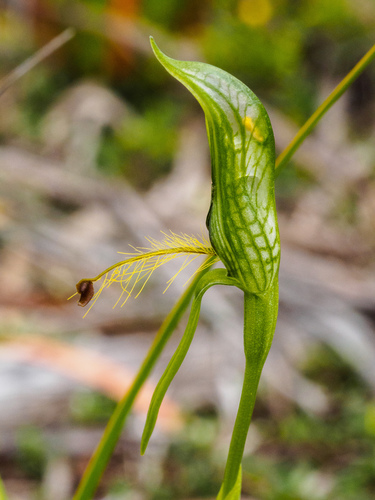
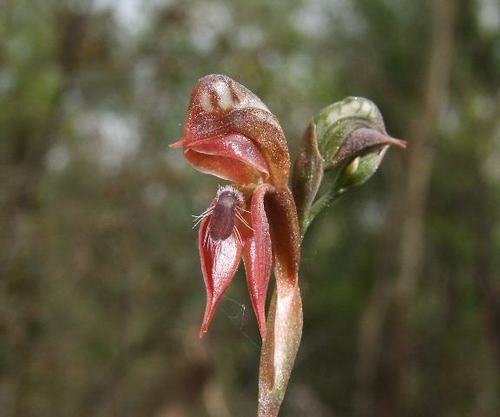
Pterostylis squamata R.Br. is a terrestrial, perennial, deciduous herb that grows from an underground tuber. Non-flowering individuals produce a rosette of four to eight oblong leaves, each measuring 10–30 mm (0.4–1 in) long and 7–12 mm (0.3–0.5 in) wide. Flowering plants bear up to ten translucent green flowers marked with reddish-green, held on a flowering spike 100–300 mm (4–10 in) tall. Between two and six stem leaves wrap around the flowering spike. The dorsal sepal and petals are fused to form a hood, or "galea", over the column; the dorsal sepal has an upturned, thread-like tip about 2 mm (0.08 in) long. The lateral sepals are roughly the same width as the galea, are egg-shaped and turned downwards, are joined for part of their length, and taper to a narrow or thread-like tip 4–7 mm (0.2–0.3 in) long. The labellum is insect-like, about 4 mm (0.2 in) long and 2 mm (0.08 in) wide, and is dark reddish brown and fleshy. There are five to seven hairs up to 2 mm (0.08 in) long on each side of the labellum, and many shorter hairs on its "head" end. Flowering takes place between October and March. This species, commonly called southern rustyhood, grows in heath, woodland and forest, most often near rock outcrops. It occurs south from the Brindabella Range in New South Wales and the Australian Capital Territory, with scattered populations across Victoria and a widespread distribution in Tasmania.