About Pterostylis robusta R.S.Rogers
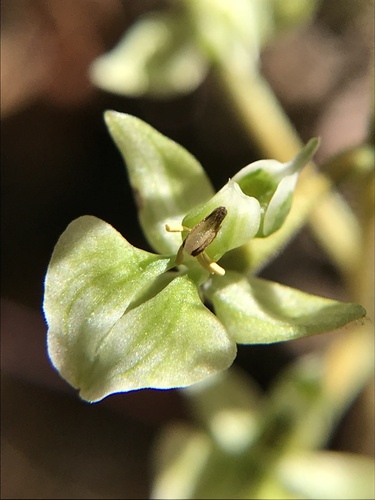
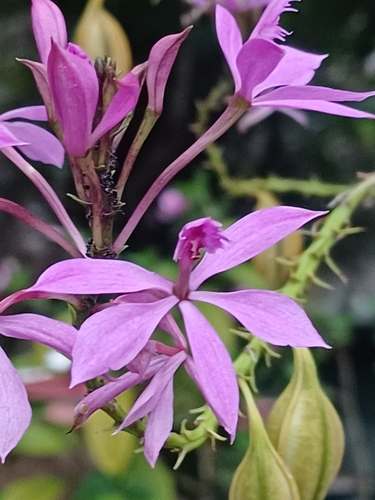
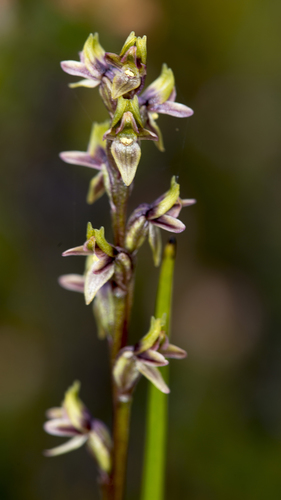
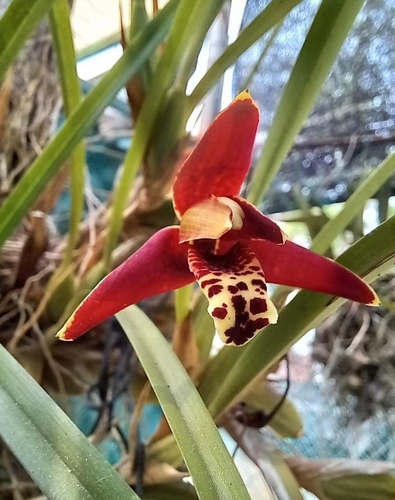
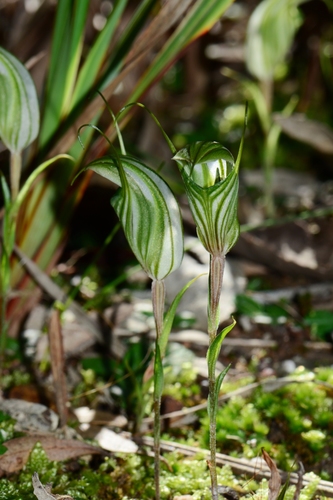
Pterostylis robusta R.S.Rogers is a terrestrial, perennial, deciduous herb that grows from an underground tuber. When it is not flowering, it produces a rosette of four to ten dark green, egg-shaped leaves. Each leaf measures 10–25 mm in length and 10–16 mm in width. Flowering plants produce a single flower that is 27–35 mm long and 10–12 mm wide, borne on a stalk 50–200 mm high, with three to seven spreading stem leaves. The flowers are green, white, and brownish, with a reddish-brown tinge or stripes. The dorsal sepal and petals are fused together to form a hood, also called a "galea", that covers the column. The dorsal sepal curves forward and ends in a sharp point 2–4 mm long. The lateral sepals are held upright, pressed close against the galea, and have an erect thread-like tip 20–30 mm long. There is a flat sinus with a small notch between the bases of the two lateral sepals. The labellum is 12–15 mm long, 3–4 mm wide, dark brown or green, and is just visible inside the flower. Flowering of this species takes place from April to August. This species, commonly called the sharp-leaf greenhood, is most common in higher rainfall areas of South Australia, where it sometimes forms large, extensive colonies. In Victoria, it grows in open forest in the north-west of the state. It is rare in New South Wales, where it grows on sheltered ridges south of Wagga Wagga.