About Pterostylis planulata D.L.Jones & M.A.Clem.
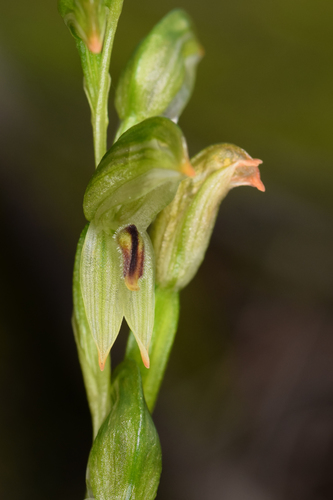
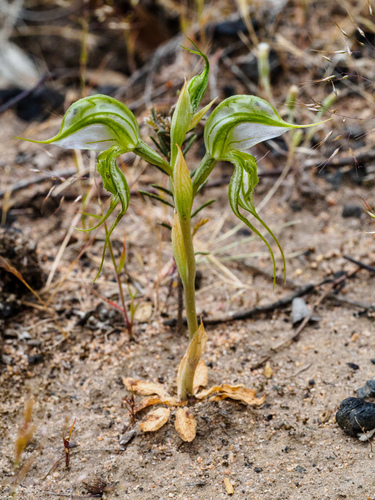
Pterostylis planulata D.L.Jones & M.A.Clem. is a terrestrial, perennial, deciduous herb that grows from an underground tuber. It produces a rosette of 5 to 8 leaves at the base of its flowering spike; each leaf measures 18–300 mm (0.7–10 in) long and 5–8 mm (0.2–0.3 in) wide, and leaves are often already withered when flowering begins. Up to seven translucent, green-striped flowers grow on a 100–200 mm (4–8 in) tall flowering spike; each flower is 30–35 mm (1.2–1.4 in) long and 9–11 mm (0.35–0.43 in) wide. Three or four stem leaves wrap around the flowering spike. The dorsal sepal and petals fuse to form a hood called a "galea" over the column, and the dorsal sepal ends in a thread-like tip 20–30 mm (0.8–1 in) long. The lateral sepals are slightly wider than the galea, have dense hairs on their outer edges, and taper abruptly to a 20–35 mm (0.8–1 in) long thread-like tip. The tips of the lateral sepals are roughly parallel to one another and sit about 10 mm (0.4 in) apart. The labellum is thin, green, and insect-shaped, measuring around 6–7 mm (0.2–0.3 in) long and 3 mm (0.1 in) wide. Two long bristles grow on the "head" end of the labellum, and 18 to 24 shorter bristles grow along its sides. Flowering occurs between October and November. This species, commonly known as the flat rustyhood, is only found in the northern section of Grampians National Park, where it grows in shallow soil on rock ledges.