About Pterostylis parviflora R.Br.
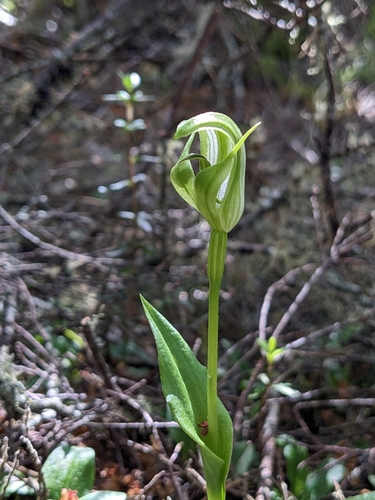
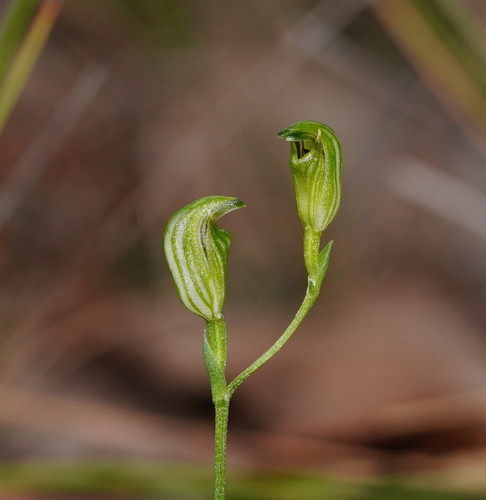
Pterostylis parviflora is a terrestrial, perennial, deciduous herb that grows from an underground tuber. When it is not flowering, it produces a rosette of three to eight egg-shaped to heart-shaped leaves that lie flat against the ground. Each individual leaf measures 3–15 mm long and 3–7 mm wide. Flowering plants produce up to eight well-spaced flowers, each 7–10 mm long and 3–4 mm wide, carried on a thin, wiry flowering spike that is 80–250 mm tall. Up to three leaf rosettes grow along the side of this flowering spike. The flowers are green and white, and sometimes have brown coloring on the petals. The dorsal sepal and petals are fused together to form a hood, also called a "galea", that covers the column. The dorsal sepal curves forward and ends in a short point. The lateral sepals stand erect, held close against the galea, with thread-like tips about 3 mm long that do not extend above the galea. The notch (sinus) between the bases of the lateral sepals bulges forward and has a small indentation at its center. The labellum is about 4 mm long and 1.5 mm wide, and is barely visible above the sinus. Flowering takes place from February to May. This species, commonly known as the tiny greenhood, grows in a variety of habitats from coastal heath to forest, in moist, well-drained soils. It is widespread across the coast and ranges of New South Wales, the Australian Capital Territory, Tasmania, and most of Victoria. It also occurs in Queensland, and is rare in South Australia.