About Pterostylis ophioglossa R.Br.
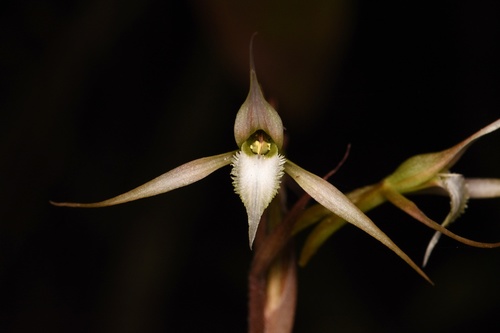
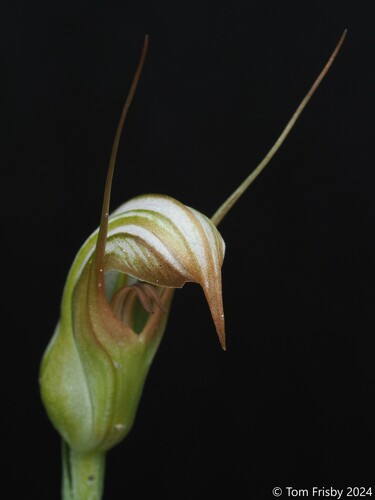
Pterostylis ophioglossa R.Br. is a terrestrial, perennial, deciduous herb that grows from an underground tuber and produces a rosette of four to six egg-shaped leaves. Each leaf measures 15–25 mm (0.6–1 in) long and 4–20 mm (0.2–0.8 in) wide. When flowering, plants retain a similar rosette and produce one dull green, brown, and white flower on a flowering spike 100–250 mm (4–10 in) tall. The flowers are 25–30 mm (0.98–1.2 in) long, 10–13 mm (0.4–0.5 in) wide, and lean forward. The dorsal sepal and petals are fused, curving forward to form a hood-like structure called a "galea" over the column; the dorsal sepal is longer than the petals and ends in a pointed tip 2–3 mm (0.08–0.1 in) long. A flat, broad U-shaped sinus sits between the two lateral sepals, which bear erect, thread-like tips 22–30 mm (0.9–1 in) long. The labellum protrudes above the sinus; it is 13–16 mm (0.5–0.6 in) long, about 3 mm (0.1 in) wide, curved, brown, and has a deep notch at its tip. Flowering takes place between April and July. This species, commonly called the snake-tongue greenhood, grows in sheltered sites within forest and scrub in coastal areas between Sydney, New South Wales and Eungella, Queensland.