About Pterostylis nutans R.Br.
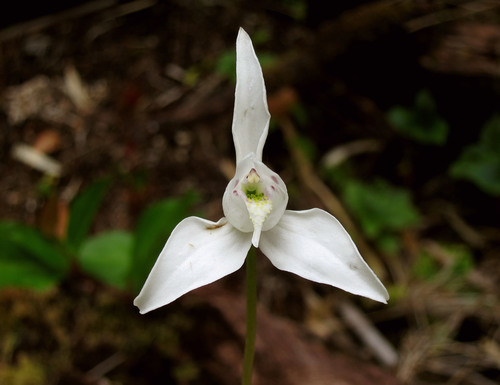
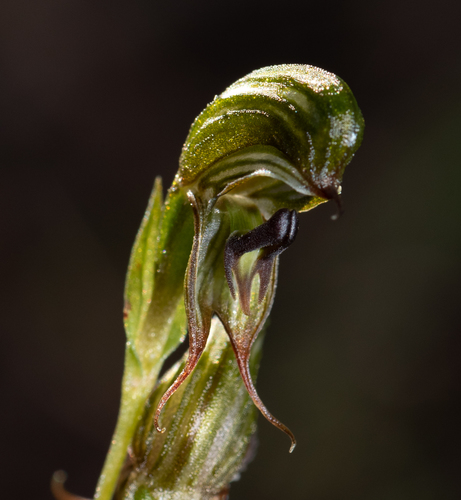
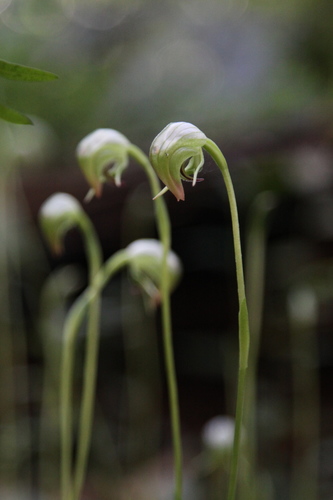
Pterostylis nutans R.Br. produces a rosette of three to six egg-shaped to elliptic leaves. Each leaf measures 15–30 mm (0.6–1 in) long and 10–20 mm (0.4–0.8 in) wide, is dark green, has wavy margins, and grows on a distinct petiole. A single translucent white flower marked with green stripes and brown colouring grows on a flowering stalk 80–300 mm (3–10 in) tall, and the flower is strongly nodding, meaning it leans sharply forwards. The flower itself is 18–25 mm (0.7–1 in) long and 10–14 mm (0.4–0.6 in) wide. A wide gap exists on each side of the flower between the petals and the lateral sepals. The lateral sepals curve forwards, have tapering tips, and measure 10–18 mm (0.4–0.7 in) long, with a deeply notched sinus between them. The labellum protrudes from the flower; it is 14–18 mm (0.6–0.7 in) long and 4 mm (0.2 in) wide, curved, blunt, green and brown, and covered in short, bristly hairs. Flowering takes place from March to December.
This species, commonly called the nodding greenhood, often forms large colonies in moist, protected forest habitats. It is native to the Australian states of Queensland, New South Wales, Victoria, South Australia and Tasmania, as well as the Australian Capital Territory. In Queensland, its range extends north to the Atherton Tableland; it grows in the eastern half of New South Wales, the southern half of Victoria, the south-eastern corner of South Australia, and across Tasmania including King Island and Flinders Island. It has also been found in New Zealand, where it is considered a vagrant because its insect pollinator does not occur there. Only a single population remains near the Waihaha River, though historical records exist from Kaitaia and Castor Bay.
This greenhood orchid is pollinated by one specific species of fungus gnat. The gnat is attracted by a kairomone produced by the flower's labellum. The labellum tips the insect into the flower, and as the insect attempts to escape, it comes into contact with the flower's sexual organs to complete pollination.
In horticulture, Pterostylis nutans grows easily in pots filled with a free-draining sandy potting mix. Plants need regular watering during their growing season, must be kept dry when dormant, and require annual repotting.